Firm/Maker Record
Atelier Robalbhen
The Parisian stoneware atelier that produced, under the name Robalbhen, a decade of sculptural vegetal ceramics closely bound to the painter Henri Laurent-Desrousseaux — and whose authorship remains one of the most contested attribution questions in French Art Nouveau ceramics.
Historical Note
For roughly a decade around 1900, sculptural stoneware appeared in Paris under the name Robalbhen. The pieces are unmistakable: vessel walls from which vegetal growth — chestnut leaves, seed pods, swelling buds — emerges in mid and high relief, under matte and flowing enamels in violets, browns, reds and ochres. They were shown at the Paris Salons between 1897 and 1905, where the period photographs collected by Alastair Duncan record an output overwhelmingly vegetal and floral, and they were inscribed, in black glaze or incised, “Robalbhen / Paris.” The enterprise was bound to a single career — that of the painter and illustrator Henri Laurent-Desrousseaux (1862–1906), whose biography is given on his own page — and it did not survive his death at Valmondois in August 1906.
Who, or what, was Robalbhen? The question is the atelier’s central puzzle, and this archive presents it openly. One reading — adopted in this catalogue, following Florence Slitine’s study of art ceramics in the Île-de-France — holds that Henri-Léon-Charles Robalbhen and Henri Laurent-Desrousseaux were separate but closely associated figures, the one lending the enterprise its name, the other his hand. The other reading, current at the Musée d’Art et d’Histoire Louis-Senlecq at L’Isle-Adam, which owns a Robalbhen vase, and in most reference sources, holds that Robalbhen was simply the pseudonym under which Laurent-Desrousseaux signed his ceramics. The Metropolitan Museum of Art splits the difference on its own credit line, attributing its vase to “perhaps” Laurent-Desrousseaux, with Robalbhen noted as his possible pseudonym.
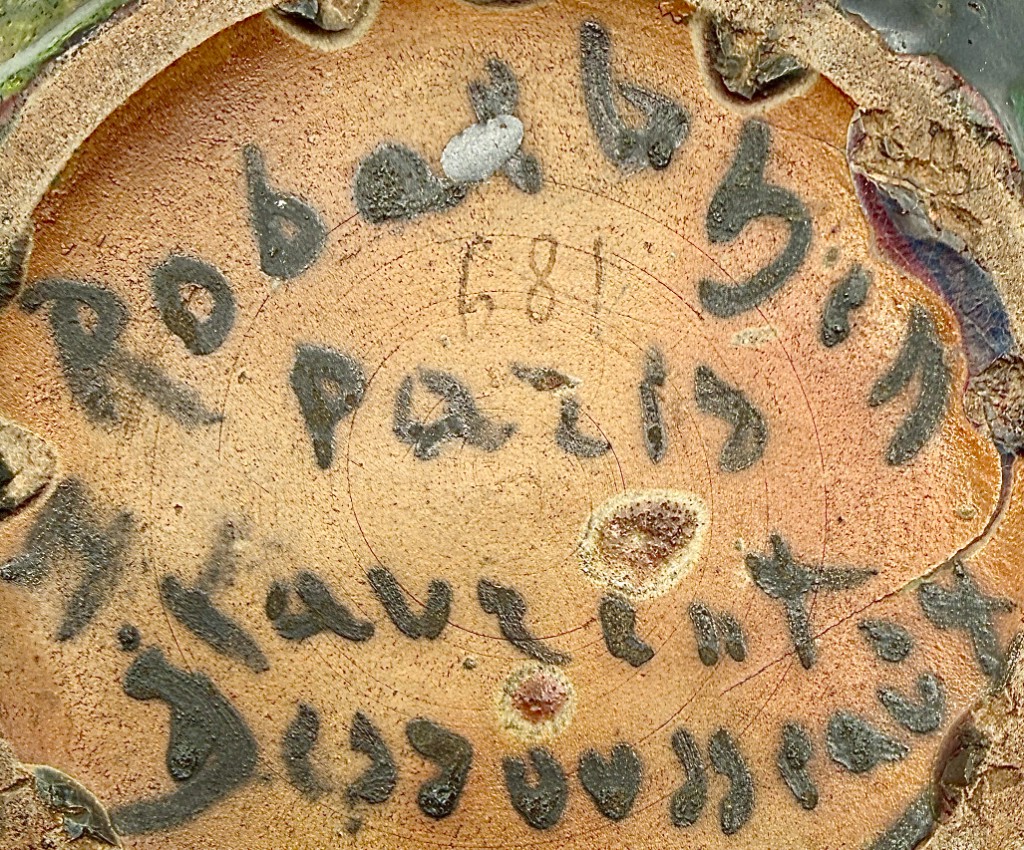
The physical evidence cuts both ways. The collection’s starfish-and-coral vase carries both names in the same hand — “Robalbhen / Paris / H. Laurent Desrousseaux,” written in black glaze above the incised number 681 — a doubling that would be odd in one man’s signature, and the strongest card the two-figure reading holds. Yet the databases that list two artists assign both the same birth and death years, 1862 and 1906 — the classic signature of one man’s dates duplicated across a split identity. A third possibility reconciles them: Robalbhen as the trading name of the ceramic enterprise itself, inscribed as the workshop, with Laurent-Desrousseaux added as the artist — a reading that would make the title of this page exactly correct while leaving no second man to account for. A commercial registration, a Salon entry naming both men, or a civil record for a Henri-Léon-Charles Robalbhen would settle the matter; none has yet surfaced.
The production such a record would explain is small, coherent and intense. Surviving vases carry incised studio numbers in what appears to be a single continuous series — 275, 681 and 1302 are recorded — a sequence that, as more examples surface, may allow the decade’s output to be ordered and dated. The repertory is the garden and the woodland brought to the kiln: leaves and pods modeled so that they seem to grow from the vessel rather than decorate it. Examples are reproduced by Paul Arthur, by Bernd Hakenjos in the Hetjens-Museum’s survey of Jugendstil ceramics, and in the Metropolitan Museum’s vase with leaves and seed pods; the collection’s starfish-and-coral vase of c. 1896 is the production’s one known departure from that vegetal world, carrying the same modeled-growth language below the tide line.
The atelier ends where the career ends. No successor took up the name, no stock or models are known to have passed to another firm, and the pieces are correspondingly rare. Within the Bestiaire, Atelier Robalbhen stands beside Henri Laurent-Desrousseaux as the issuing house stands beside the artist elsewhere in this archive — a division the objects themselves impose, since the name on the clay is Robalbhen, whatever its bearer proves to have been. The starfish-and-coral vase is thus doubly valuable here: a rare marine subject in a vegetal œuvre, and, with its two names in one hand, the chief exhibit in the identity question this page leaves honestly open.
Literature
Paul Arthur, French Art Nouveau Ceramics: An Illustrated Dictionary. Paris: Éditions Norma, 2015, p. 234. Reproduces a vase of closely related decoration and situates the Robalbhen production within the Paris ateliers.
Alastair Duncan, The Paris Salons 1895–1914, vol. IV: Ceramics and Glass. Woodbridge: Antique Collectors’ Club, 1998, pp. 363–367. Period photographs of the ceramics exhibited between 1897 and 1905 — the essential visual record of the atelier’s Salon production, and the demonstration of how exceptional the marine subjects are within it.
Bernd Hakenjos, Europäische Keramik des Jugendstils. Exhibition catalogue, Hetjens-Museum, Düsseldorf, 1974, model no. 104, reproduced p. 86. An early museum appearance of the stoneware in the Jugendstil canon.
Florence Slitine, La céramique d’art en Île-de-France: Ateliers et manufactures privés autour de Paris (1850–1950). Paris: Mare & Martin, 2024, pp. 599–600. The current specialist treatment of Laurent-Desrousseaux and Robalbhen, and the basis of this catalogue’s handling of the identity question.