Artist Dossier
André Metthey
A self-taught potter who began in high-fired stoneware before turning to glazed earthenware and lending his blanks to the painters of the Fauve circle; his frogs, snails and crabs belong to the earlier and wholly ceramic phase of that career.
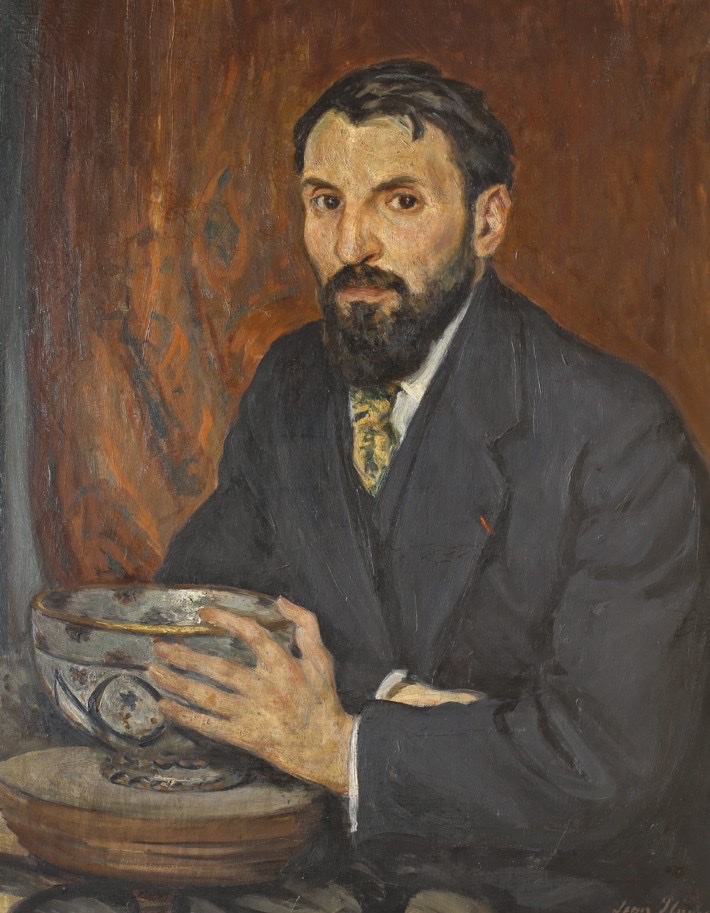
Biographical Note
André Metthey was born at Laignes in Burgundy and grew up in Dijon, where he entered a marble worker’s shop while still a boy and studied industrial art at the city’s École des Beaux-Arts. After moving to Paris, he worked as an ornamental sculptor before turning decisively toward ceramics in the late 1890s. Inspired in part by Jean Carriès and the revival of high-fired stoneware, Metthey taught himself the difficult chemistry of clay, glaze and firing. He exhibited grès flammé at the Salon des Indépendants in 1901 and established his workshop at Asnières-sur-Seine in 1903.
Metthey’s early ceramics retain the force and physicality of sculpture. His stoneware vessels are often asymmetrical, thickly modeled and covered with mottled green, brown and blue glazes that gather unpredictably in depressions and reliefs. Animals were particularly suited to this tactile language. Frogs cling to the swelling body of a vessel; snails emerge from folds of clay; crabs spread horizontally across low, functional forms. Rather than being applied as genteel decoration, these creatures appear to inhabit the material itself, their damp skins, shells and limbs suggested by the weight of the clay and the movement of the glaze. This early animal imagery combines close observation with rustic humor and the experimental spirit of French Art Nouveau stoneware.
Between 1906 and 1911, Metthey’s Asnières workshop became an important meeting place between ceramics and avant-garde painting. With the encouragement of the dealer Ambroise Vollard, he supplied vessels and white-glazed earthenware forms to artists including Henri Matisse, André Derain, Maurice de Vlaminck, Georges Rouault and Jean Puy. Their boldly painted ceramics were exhibited at the Salon d’Automne and helped establish the vessel as a legitimate field for modern painting. Metthey was not merely a technician in these collaborations: his command of form, glaze and firing made the experiment possible, while the Fauves’ direct handling of color encouraged a freer and increasingly painterly character in his own work.
From around 1910, Metthey moved away from the rugged naturalism of his earliest stoneware toward more refined earthenware and richly decorated surfaces. His later ceramics draw strongly upon Persian and Ottoman traditions—particularly the brilliant color, rhythmic ornament and clear outlines associated with Iznik pottery. Saturated blues, greens, purples and reds appear against pale grounds, frequently enriched with gilding or metallic accents. Floral scrolls, geometric borders and repeating figures encircle bowls, dishes and vases in compositions conceived less as sculptural episodes than as continuous fields of color. Metthey absorbed these historical sources without simply reproducing them, translating their ornamental discipline into a modern, unmistakably personal language. His career was interrupted during the First World War, but he resumed production before his death at Asnières in 1920.
Animals remained important throughout this stylistic transformation. In the early works they are modeled bodies—frogs, snails and crustaceans whose forms disrupt or even determine the vessel. In the later ceramics, animals become flatter, brighter and more rhythmic: birds, hares, deer, fish and other creatures repeat around rims or move through ornamental gardens of leaves and flowers. The change from relief modeling to painted pattern reflects the broader development of Metthey’s art, from the earthy materialism of Art Nouveau stoneware to a decorative language approaching Art Deco. Across both phases, however, he treated animals not as incidental motifs but as active partners in the shape, movement and character of the ceramic object.
Literature
Arthur, Paul. French Art Nouveau Ceramics: An Illustrated Dictionary. Paris: Éditions Norma, 2015. The standard dictionary; its Metthey entry underlies the biographical outline above.
Clouzot, Henri. André Metthey, décorateur et céramiste. Paris: Librairie des Arts décoratifs, n.d. [c. 1925]. The album of forty-five plates issued after the posthumous Galliera retrospective, and for a century the only monographic publication; copies are variously dated by libraries between 1920 and 1926.
Duncan, Alastair. The Paris Salons, 1895–1914. Vol. IV: Ceramics and Glass. Woodbridge: Antique Collectors’ Club, 1998. Period photographs of Metthey’s early grès at p. 333, including variants of the collection’s snail and frog vases.
Lacotte, Adélaïde. “André Metthey (1871–1920), au-delà de sa rencontre avec les Fauves: cercle de collectionneurs autour du céramiste.” Sèvres. Revue de la Société des Amis du Musée national de Céramique, no. 28, 2019. On the collectors who sustained Metthey’s personal work beyond the Fauve collaboration; reproduces Jean Plumet’s portrait of the ceramist used above, and relays Georges Toutlemonde’s testimony on the signature change of 1911 (see Toutlemonde 1971).
Lacotte, Adélaïde. “L’œuvre du céramiste André Metthey (1871–1920): art de la céramique et céramique d’artiste.” PhD dissertation, Université Paris 1 Panthéon-Sorbonne, 2023. Defended December 2023 under Emmanuel Pernoud; the first doctoral study of the œuvre (theses.fr 2023PA01H088).
Lacotte, Adélaïde, and Sylvain Pinta, eds. André Metthey: la quête du feu et de la couleur. Exhibition catalogue, MUDO – Musée de l’Oise, Beauvais, 26 March – 18 September 2022. Paris: Lienart éditions, 2022. The first full monograph, from the early grès to the late terres vernissées; a period postcard at p. 34, fig. 17, shows snail vases related to the collection’s example.
Toutlemonde, Georges. “Souvenirs sur le céramiste André Metthey: 1871–1920.” Les cahiers de la céramique, du verre et des arts du feu, no. 50, September–December 1971, pp. 23–27. The stepson’s memoir, and the source for Metthey’s correction of his signature from “Méthey” to “Metthey” upon the Légion d’honneur of 1911 — the spelling that dates early works.
Verneuil, Maurice Pillard. “Les Objets d’art à la Société des Artistes Français.” Art et Décoration, July 1903, p. 229. The period review that singles out Metthey’s snail- and frog-decorated grès at the 1903 Salon — the models of two works in the collection.