Artist Dossier
Henri Laurent-Desrousseaux
A painter and illustrator, born to two painters and known by his mother’s surname, Laurent-Desrousseaux was drawn to ceramics by Camille Moreau-Nélaton and devoted the final decade of his career to the sculptural stoneware issued under the Robalbhen name, where vegetal growth seems to emerge from the vessel wall and, in the collection’s starfish-and-coral vase, the same organic language is transformed into a tidal pool.
Biographical Note
Henri Alphonse Louis Laurent was born at Joinville-le-Pont, on the Marne just east of Paris, on July 15, 1862, into a household in which both parents painted: his father, Henri Adolphe Louis Laurent, born at Valenciennes in 1830, and his mother, Lydie Adèle Laurent-Desrousseaux, born at Cherbourg in 1836. It was his mother’s surname by which he became known, and under which his whole career was conducted — a quiet fact worth registering in a catalogue much concerned with what signatures do and do not tell us. The Bestiaire has one parallel case in Alphonse Voisin-Delacroix, who carried his grandfather’s name; in both, the chosen name is the true one for the historical record, and the birth name survives only in the civil registers.
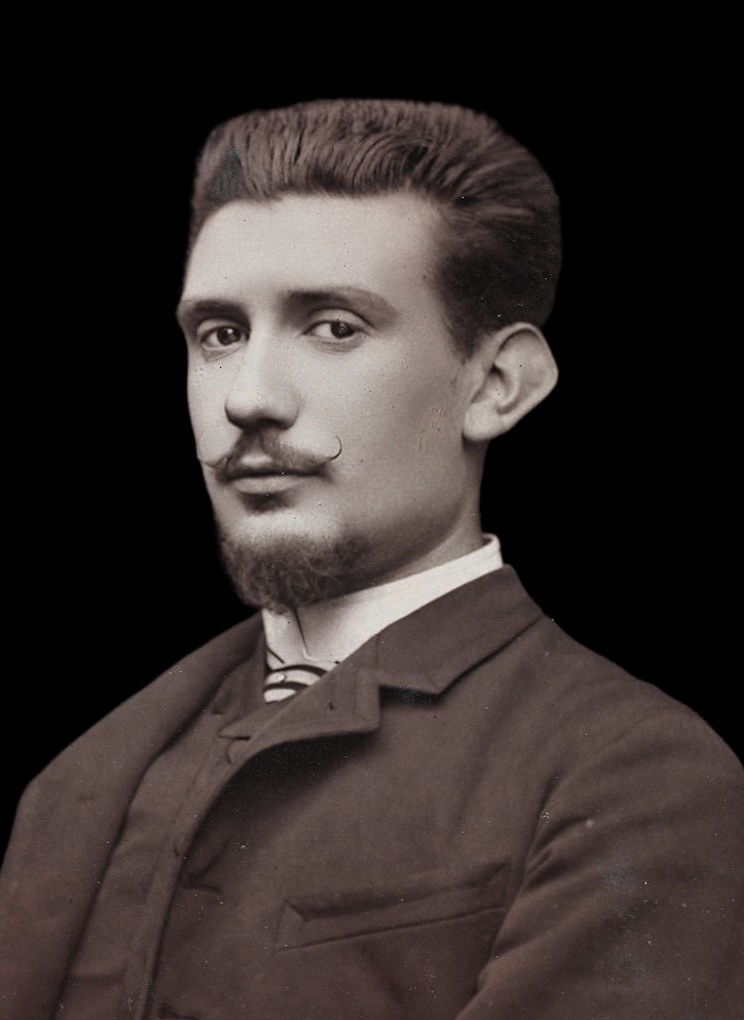
He entered the École nationale supérieure des beaux-arts in 1881, training under Émile Bin and Albert Maignan, and was showing at the Salon within a few years — the photographer Charles Michelez included the twenty-three-year-old among the exhibitors portrayed in his album of the 1885 Salon, the portrait reproduced above. As a painter he worked in religious subjects and landscape, and he was recognized at the Salons and at both the 1889 and 1900 Expositions Universelles. Alongside the painting ran a busy career in illustration: he drew for Le Figaro illustré and La Mode pratique, and supplied watercolors for editions of Alphonse Daudet’s Le Trésor d’Arlatan and André Theuriet’s Reine des bois. The illustrator’s discipline — close, patient observation of natural form in the service of a text — is worth holding in mind when one comes to the naturalist precision of his ceramics.
The turn came through Camille Moreau-Nélaton (1840–1897), painter and ceramist and mother of the collector and historian Étienne Moreau-Nélaton. Drawn to ceramics by her example, Laurent-Desrousseaux devoted the final decade of his career, from about 1896, to sculptural stoneware issued under the Robalbhen name from an atelier in Paris. The period photographs gathered in Alastair Duncan’s survey of the Salons, where the atelier’s ceramics appear steadily between 1897 and 1905, show a production overwhelmingly vegetal: orchids, vines, gourds and seedpods modeled in mid-relief, with experimental glazes pooling around them, so that growth seems to emerge from the vessel wall rather than to be applied upon it. He lent his hand to glass as well, engraving designs for the Verrerie de la Paix on the avenue de l’Opéra — a reminder that the decade was a widening of media, not a renunciation of the others.
The Robalbhen name itself is the unresolved question of his ceramics, and this catalogue keeps the dispute where it belongs, on the Atelier Robalbhen page. Stated briefly: most French institutional sources treat Robalbhen as his pseudonym; Florence Slitine’s recent study of the Île-de-France ateliers proposes instead two separate but closely associated figures; and the collection’s own vase, inscribed “Robalbhen / Paris / H. Laurent Desrousseaux” in a single hand, is evidence claimed by both readings. This page therefore says only what every reading allows: the ceramics were exhibited and marketed under the Robalbhen name, and the hand and the artistic identity behind the stoneware that concerns this collection are Laurent-Desrousseaux’s.
Within that overwhelmingly vegetal production, the Bestiaire’s starfish-and-coral vase of about 1896 stands as a deliberate departure: the same organic language — form growing from the vessel wall, glaze gathering like sediment — transformed from the hothouse to the tidal pool, with encrusting and branching corals distinguished with an accuracy that betrays the trained illustrator. It is the kind of object that shows why his stoneware belongs in the climate of Carriès and Delaherche rather than among the decorators: the vessel is not ornamented with marine life; it is imagined as a surface on which marine life has settled.
Laurent-Desrousseaux settled at Valmondois, in the Val-d’Oise, at the end of his life, and died there on August 11, 1906, at forty-four. The atelier did not survive him, and the shortness of the run — barely a decade — accounts for the rarity of the work. His memory is best kept in the valley where he died: the musée d’Art et d’Histoire Louis-Senlecq at L’Isle-Adam, a few kilometers from Valmondois, acquired one of his vases in 2016 and holds material on his last years.
Literature
Arthur, Paul. French Art Nouveau Ceramics: An Illustrated Dictionary. Paris: Éditions Norma, 2015, p. 234. Reproduces a vase of closely related decoration and situates the Robalbhen production within the Paris ateliers.
Duncan, Alastair. The Paris Salons 1895–1914, vol. IV: Ceramics and Glass. Woodbridge: Antique Collectors’ Club, 1998, pp. 363–367. Period photographs of the ceramics exhibited between 1897 and 1905 — the essential visual record of the atelier’s Salon production, and the demonstration of how exceptional the marine subjects are within it.
Hakenjos, Bernd. Europäische Keramik des Jugendstils. Exhibition catalogue, Hetjens-Museum, Düsseldorf, 1974, model no. 104, reproduced p. 86. An early museum appearance of the stoneware in the Jugendstil canon.
Slitine, Florence. La céramique d’art en Île-de-France: Ateliers et manufactures privés autour de Paris (1850–1950). Paris: Mare & Martin, 2024, pp. 599–600. The current specialist treatment of Laurent-Desrousseaux and Robalbhen, and the basis of this catalogue’s handling of the identity question.