Artist Dossier
Horace Désiré Bieuville
One of Sèvres’s great painter-decorators and an occasional designer of ceramic forms, although his authorship of the Manufacture’s remarkable 1897 four-frog vase remains a published attribution rather than a documented certainty.
Biographical Note
Horace Désiré Bieuville was one of the Manufacture nationale de Sèvres’s most accomplished and enduring decorators. Born at Meudon in 1862, he entered the manufactory in 1879 and remained active there until 1925; the place of his death is not yet confirmed. Official records describe him principally as a peintre sur porcelaine, but his responsibilities extended beyond the execution of painted decoration. The Sèvres collections preserve more than two hundred drawings attributed to him, including projects for individual vessels, floral and animal ornament, and complete decorative compositions. His long career carried him from the elaborate historicism of the late nineteenth century through Art Nouveau and into the more stylized vocabulary of the early Art Deco period.
Bieuville decorated forms created by artists such as Albert-Ernest Carrier-Belleuse, while also receiving credit for designing certain forms himself. The clearest instance is the Vase de Beauvais of 1912, in hard porcelain under a crystallized grand-feu glaze, which is credited to him in at least three public collections — the musée d’Orsay, La Piscine at Roubaix and the musée des Beaux-Arts de Lyon — besides the pair published by Zehil; the Petit Palais likewise records him as the author of the model for the Vase de Mennecy “Agitarium” of 1903. That a named vase form of his stands in several national and municipal collections is the strongest evidence that his work at Sèvres was not confined to painting. His work was shown at the Paris Exposition Universelle of 1900 and included ambitious naturalistic and ornamental subjects — swans, flowers, lizards, cats and other animals — treated with the control of silhouette, surface and color expected of Sèvres’s leading decorators.
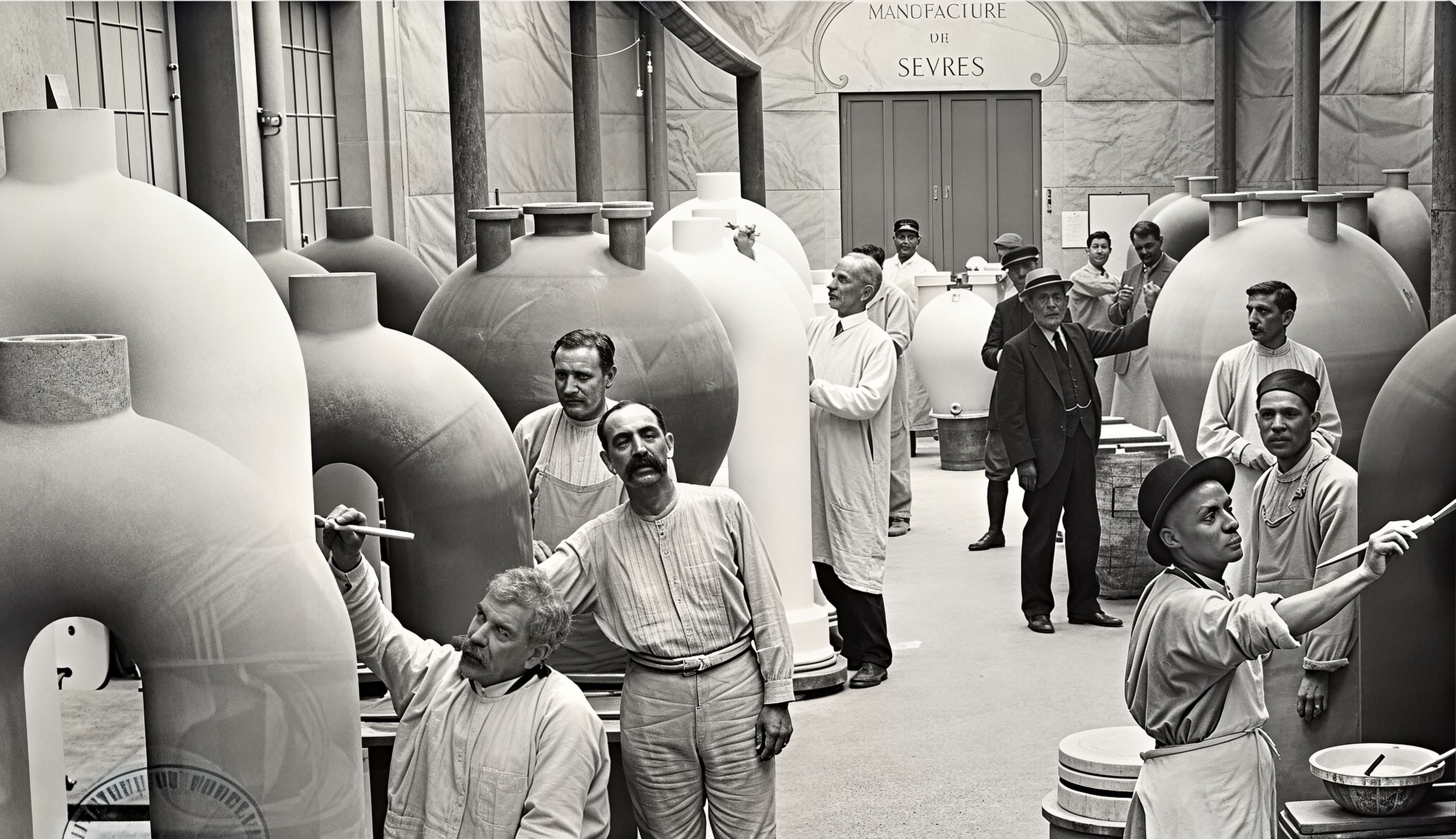
Alastair Duncan published the present 1897 four-frog vase under Bieuville’s name, but the attribution should be stated cautiously, and it is worth being exact about what Duncan’s page actually is. It reproduces a single undated period photograph of a row of vases, captioned only with a list of seven makers from left to right; the attribution to Bieuville therefore rests on matching a name’s position in that list to an object’s position in the row. The vase bears Sèvres model and date marks but no signature identifying Bieuville, and no corresponding model drawing or factory record has yet been located. Duncan’s assignment consequently does not establish whether Bieuville conceived the entire vessel, modeled its frogs, or supplied a preliminary design.
Literature
Brunet, Marcelle, and Tamara Préaud. Sèvres: des origines à nos jours. Fribourg: Office du Livre; Paris: Société Française du Livre, 1978. The standard general history of the manufactory.
Duncan, Alastair. The Paris Salons, 1895–1914, vol. IV: Ceramics and Glass. Woodbridge: Antique Collectors’ Club, 1998, p. 434. The period photograph publishing the four-frog vase under Bieuville’s name, captioned left to right with seven makers.
Fichier du personnel de la Manufacture de Sèvres. French Porcelain Society. A roster of Sèvres personnel with roles and dates of service, and the tool for confirming Bieuville’s position and tenure against those of his colleagues in the Duncan caption.
Ministère de la Culture. “Un cabinet d’arts graphiques à Sèvres.” Documents Bieuville’s service at the Manufacture from 1879 to 1925 and the approximately 202 drawings preserved there — the collection in which a model drawing for the frog vase would be found if one exists.
Zehil, Robert. The Magic of Sèvres. Monaco: Robert Zehil Gallery, 2020, p. 102. A pair of Vases de Beauvais, identifying Bieuville as the designer of the form.