Firm/Maker Record
Renoleau, Goras & Cie
The short-lived partnership of Alfred Renoleau and François Goras established an important school of naturalistic art pottery at Angoulême and laid the foundation for Renoleau’s later independent manufactory.
Historical Note
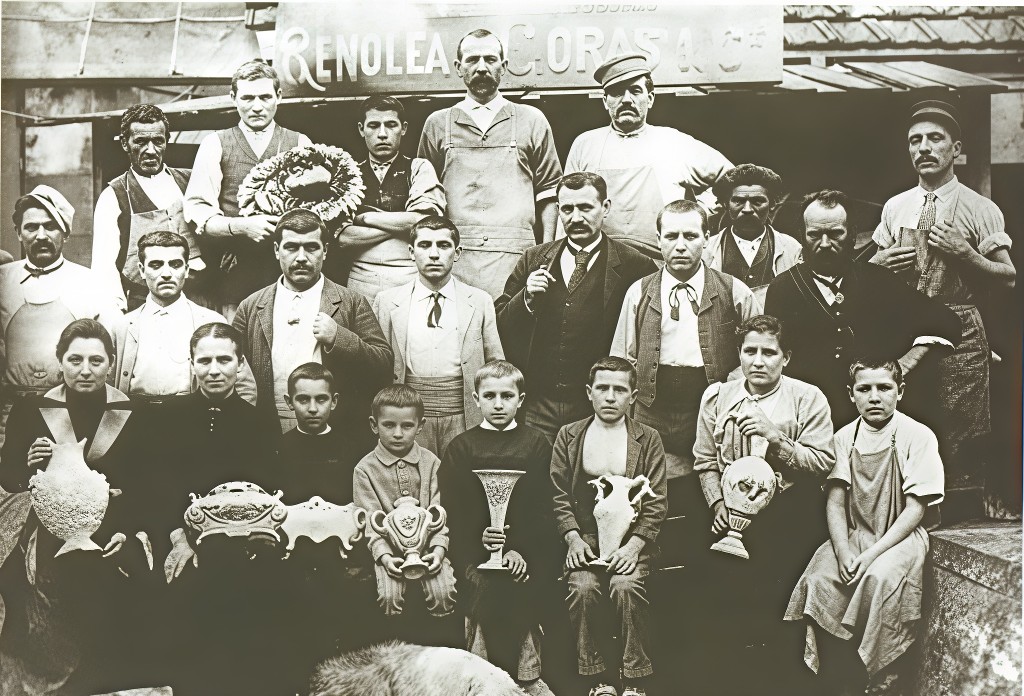
Renoleau, Goras & Company was formed in Angoulême in 1892 by Alfred Renoleau and François Goras, a Limoges-born painter on porcelain who had settled in the city during the previous decade; some accounts date the founding to 1891, and the question is discussed below. Renoleau brought practical experience acquired at the Polakowski works in Roumazières, where he had been engaged to make dishes in the Palissy taste for the firm’s best clients and had worked under the molder-modeler Sylvestre Bourigeaud (1863–1941), and, more consequentially for what followed, a period in the Paris atelier of Georges Pull, the leading Palissy revivalist of the day. Goras contributed the training of a professional ceramic painter and decorator. Their workshop in the Port de l’Houmeau district produced both ordinary tableware and ambitious faïence d’art, helping to renew Angoulême’s much older ceramic tradition.
The firm became particularly distinguished for its revival of Palissy’s rustiques figulines — a lineage it could claim directly, through Renoleau’s time with Pull, rather than only by imitation at a distance. Large dishes and wall platters were modeled in high relief with fish, eels, crayfish, crabs, frogs, reptiles, shells and aquatic plants, then covered with translucent colored glazes that emphasized wet skin, scales, shells and vegetation. The finest examples move beyond the arrangement of natural-history specimens characteristic of much nineteenth-century Palissy ware. Their animals occupy coherent riverbank or tidal environments in which overlapping bodies, water, foliage and glaze create a continuous field of organic movement.
Surviving objects bear several related marks. The partnership’s most characteristic signature combines the capital letter A, denoting Angoulême, with a city gate flanked by two crenelated towers and the inscription RG Cie. Other pieces are marked F.G. & Cie, apparently emphasizing Goras’s role and sometimes complicating the division of authorship between the two men. Their complementary abilities make rigid attribution difficult in any event: Renoleau was an accomplished modeler and glaze experimenter, while Goras was himself capable of producing highly elaborate naturalistic reliefs. The objects are therefore best understood as products of a genuinely collaborative manufactory unless individual signatures or documentation establish otherwise.
Disagreements brought the partnership to an end in 1895. Renoleau subsequently founded his independent Faïencerie d’Art d’Angoulême in the former episcopal borderie, formally beginning the better-known phase of his career in 1896 and eventually moving into Art Nouveau stoneware, iridescent glazes and crystalline effects. Goras continued ceramic production separately for several years and later worked in Paris. Although Renoleau, Goras & Company existed for only a brief period, it was the crucial bridge between Renoleau’s apprenticeship at Roumazières and the mature Angoulême manufactory. Its best animal ceramics already reveal the combination of close observation, sculptural vitality and environmental unity that would distinguish his later work.
Literature
Katz, Marshall P., and Robert Lehr. Palissy Ware: Nineteenth-Century French Ceramists from Avisseau to Renoleau. London: The Athlone Press, 1996, p. 179, fig. 241. Places the firm’s naturalistic animal ceramics within the broader nineteenth-century Palissy revival and illustrates a related crab dish.
Latier, Marcel. Faïences et faïenciers d’Angoulême de 1748 à 1914. Bordeaux: Imprimerie Delmas, 1971. An earlier local history, useful for the ceramic industry that preceded Renoleau and Goras and for the position of their enterprise within Angoulême’s manufacturing tradition.
Renaud, Yvette. Alfred Renoleau: céramiste charentais. Angoulême: Centre départemental de documentation pédagogique de la Charente, 2004, especially “La Faïencerie d’Angoulême,” pp. 108–115. The principal reference for the partnership, its chronology and its factory marks; it reproduces extracts from the Renoleau, Goras et Cie catalogue and presents the main marks and signatures. Foreword by Béatrice Pannequin.