Firm/Maker Record
KPM Berlin
The Prussian royal porcelain manufactory, founded in 1763, whose brief and contested turn toward modern sculptural porcelain around 1900 produced a distinctly German ceramic bestiary: technically exacting, frequently allegorical, and poised between vessel, architecture and dream.
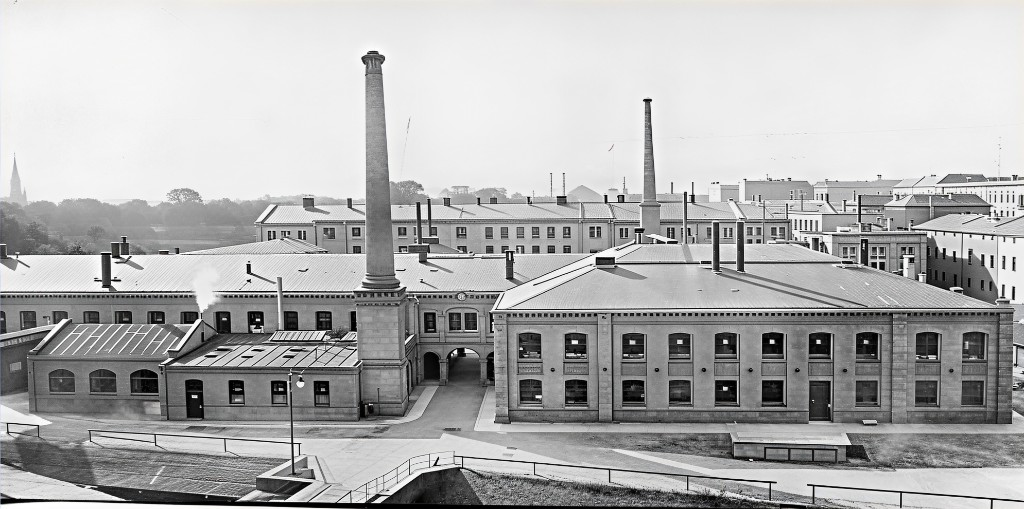
Historical Note
The Königliche Porzellan-Manufaktur Berlin (KPM) was founded on 19 September 1763, when Frederick II of Prussia acquired the porcelain enterprise established by the merchant Johann Ernst Gotzkowsky and placed it under royal ownership. It remained the property of the Prussian kings and German emperors until 1918, and long celebrated for court services, painted plaques and sculptural porcelain, it stayed closely tied to the Prussian state and its representational culture; the cobalt-blue scepter has marked its wares throughout. Between 1868 and 1872 production moved from the Leipziger Strasse, where the site was required for the building of the Prussian Landtag, to a purpose-built complex at the Wegelystrasse on the edge of the Tiergarten, erected to the designs of the architect Emil Boethke. The new works stood on the Spree with a harbor of its own, so that raw materials and finished wares could travel by water, and it was equipped with a modern ring-chamber kiln. The district was Charlottenburg, then still a separate city and not absorbed into Berlin until 1920, which is why the manufactory appears in period publications as the Kgl. Porzellan-Manufaktur, Charlottenburg. Its expanded workshops and research facilities later provided the setting for the manufactory’s engagement with Jugendstil.
The technical foundations of KPM’s modern ceramics were laid during the final decades of the nineteenth century. The Chemical-Technical Experimental Institute attached to the manufactory from 1878 — today the materials-science institute of the Technische Universität Berlin — conducted systematic research into porcelain bodies, colors, glazes and firing, and made KPM a pioneer for the German ceramic industry at large. Under the chemist Hermann August Seger, its first director, the manufactory developed in 1880 a softer porcelain body that still carries his name, together with glazes inspired partly by Chinese ceramics: oxblood reds, celadons, crystalline surfaces and flowing or mottled effects. These innovations allowed color to become an integral property of the ceramic surface rather than merely painted decoration. Seger’s successor Friedrich Hermann Marquardt, who directed the institute from 1897 to 1920, carried the work further and was decorated for it at the world exhibitions of St. Louis in 1904 and Brussels in 1910; his most consequential achievement for sculpture was a porcelain body that could be modeled directly, freehand, instead of being worked first in clay and then translated. The manufactory’s own accounts date this body to 1899, and the ceramic literature knows it as the Heinecke body; pieces from as early as July 1898 have nonetheless been identified as Heinecke porcelain, so its introduction may have run slightly ahead of the official record. Under Alexander Kips, called as artistic director in 1886 and permanently appointed in 1888, the manufactory’s public face remained monumental and historicist — his Germania Protects Art and Science, a tile picture of 1,057 painted plaques some six meters across, was the German pavilion’s centerpiece at Chicago in 1893 — even as more experimental forms began to appear beside the Neo-Rococo display pieces.
KPM’s most adventurous Jugendstil production emerged during the late 1890s and around the Paris Exposition Universelle of 1900. The manufactory engaged independent sculptors who treated porcelain as a modern plastic medium rather than a vehicle for conventional modeling. Franz Metzner produced thirty-nine documented models between July 1898 and August 1900, using the new modeling body and running or crystalline glazes to create vessels populated by masks, amphibians and hybrid creatures; the Märchen centerpiece — modeled in 1899, shown in Paris in 1900, and now more often called the Frog King — belongs to this brief but extraordinary flowering. His works translated impulses from French arts du feu ceramics into porcelain while retaining the psychological gravity and architectonic structure associated with Central European Symbolism. He was not alone: Albert Klein, Emanuel Schmutzer, Karl Bernewitz and Martin Fritzsche were working in the same idiom, and Klein’s vase with three masks of 1898 shows how far the taste for the grotesque had spread inside the manufactory. The Paris display itself was more equivocal than the surviving objects suggest. KPM’s stand was still overwhelmingly historicist, the Jugendstil pieces were relegated to the back tables, and the manufactory was judged to have shone at Paris rather more for its technical achievements — the new modeling body, the flowing and crystal glazes — than for its modern designs. That the jury and the press nonetheless singled out the modern work is the measure of how strong it was.
A second phase began with the arrival of Theodor Schmuz-Baudiß as a designer in 1902 and his appointment as artistic director, in succession to Kips, in 1908. Schmuz-Baudiß pursued a closer unity of vessel, ornament and color through simplified profiles, underglaze painting and sgraffito-like incised decoration; his Ceres service remains the best known of the results. Plants, birds, fish and other animals were reduced to strongly rhythmic patterns that encircled rather than merely illustrated the form. At the same time, KPM continued commissioning sculptural models from artists including Adolph Amberg, whose wedding procession centerpiece was begun in 1904, Joseph Wackerle and Anton Puchegger. Under Schmuz-Baudiß the manufactory’s Jugendstil evolved toward the greater geometry and decorative order of Art Deco without abandoning nature as its principal source of imagery. The monarchy ended in 1918 and the manufactory became the Staatliche Porzellan-Manufaktur Berlin, keeping its scepter mark but turning increasingly toward technical and laboratory porcelain as demand shifted. The consequences for its own recent past were severe: in February 1921 it destroyed twenty-eight of the forty forms it held from Metzner, the moulds no longer being felt to be of the moment and the space being wanted for new models.
KPM’s animals around 1900 range from independent sculptures and fairy-tale protagonists to creatures whose bodies become handles, rims, basins or entire vessels. Frogs, fish, bats and lizards inhabit Metzner’s Symbolist porcelain — a vase of October 1899 entered in the model books as a vase with dragons carries a lizard winding around its body, and the slip is characteristic of a manufactory in which the zoological and the fabulous were not always distinguished — while later designers favored more stylized and ornamental animal forms. Unlike the earthy naturalism and volatile stoneware glazes of many French workshops, KPM generally emphasized porcelain’s luminosity, precision and capacity for complex sculptural construction. Its Jugendstil production therefore represents a distinctly German contribution to the ceramic bestiary: technically exacting, frequently allegorical and poised between functional object, architectural sculpture and dream image.
Literature
Becker, Ingeborg, and Dieter Högermann. Berliner Porzellan vom Jugendstil zum Funktionalismus 1889–1939. Berlin: Bröhan-Museum, 1987. Although extending well beyond Jugendstil, the early portion is particularly useful for KPM’s colored porcelains, Seger glazes and position within the broader development of modern Berlin porcelain. It also provides an important bridge between the experimental production of the 1890s and the more functional design of the interwar period.
Hoffmann, Tobias, and Claudia Kanowski, eds. Lust auf Dekor: KPM-Porzellane zwischen Jugendstil und Art Deco — Die Ära Theo Schmuz-Baudiß. Berlin and Cologne: Wienand Verlag, 2013. Published for the Bröhan-Museum exhibition, this extensively illustrated catalogue is the principal modern study of KPM between 1902 and 1925. Its essays examine Schmuz-Baudiß’s technical and stylistic innovations, the relationship between form and decoration, and the transition from Jugendstil to Art Deco.
Osborn, Max. “Franz Metzner.” Deutsche Kunst und Dekoration, vol. 6, 1900, pp. 482–489. Records the first reception of Metzner’s fantastic human, animal and hybrid porcelain world, richly illustrated, in the same issue as Vockerat’s survey.
Siemen, Wilhelm, ed. Theodor Hermann Schmuz-Baudiss, 1859–1942: Ein Jugendstilkünstler ersten Ranges. Hohenberg an der Eger: Deutsches Porzellanmuseum, 1989. This exhibition catalogue remains an essential specialist source for Schmuz-Baudiß’s career, his work at KPM and the naturalistic and animal imagery that shaped his porcelain designs.
Sigalas, Vanessa. “Das keramische Schaffen von Franz Metzner für die Königliche Porzellan-Manufaktur Berlin (KPM).” Keramos, no. 213, July 2011, pp. 87–108. The fundamental study of Metzner’s short but transformative relationship with KPM, grounded in the factory’s model records and surviving objects. Especially important for identifying models, clarifying their dates and understanding the experimental porcelain bodies and glazes used in their production.
Treskow, Irene von. Die Jugendstil-Porzellane der KPM: Bestandskatalog der Königlichen Porzellan-Manufaktur Berlin 1896–1914. Munich: Prestel-Verlag, 1971. This 338-page volume remains the indispensable standard reference. Its tightly defined date range, archival model information, artist identifications and systematic catalogue make it the first source to consult for virtually any KPM Jugendstil object.
Vockerat, Philipp. “Die kgl. Porzellan-Manufaktur auf der Welt-Ausstellung.” Deutsche Kunst und Dekoration, vol. 6, 1900, pp. 478–482. A contemporary survey of the manufactory’s technical and artistic renewal, documenting how KPM wished its modern production to be understood at the Paris Exposition of 1900, and carrying the plate of the Märchen.