Firm/Maker Record
Émile Muller & Cie
An industrial tileworks that helped clothe the modern city in glazed ceramic, Émile Muller et Cie turned its formidable technical resources to sculptural stoneware, giving the models of leading artists body, glaze and fire—so that the animals represented in the Bestiaire, foot-warmers included, are sculptors' creatures transformed by the manufactory.
Historical Note
Émile Muller (Altkirch, Alsace, 1823–Nice, 1889) trained as an engineer before turning to ceramics. Graduating fifth in his class from the École Centrale des Arts et Manufactures in 1844, he began as a civil engineer; the monumental church in his native Altkirch was among his early projects. In 1864 he returned to the École Centrale as a professor, teaching there for twenty-four years. He also helped found the École Spéciale d’Architecture, presided over the Société des Ingénieurs Civils — where Gustave Eiffel succeeded him — and in 1853 built the workers’ housing estate at Mulhouse, an early French experiment in family housing with gardens. In 1854 Muller founded the Grande Tuilerie d’Ivry at Ivry-Port, on the Seine at the southern edge of Paris, close to clay deposits and the Paris–Basel road. The works produced interlocking mechanical tiles based on a system patented by the Gilardoni brothers, fellow natives of Altkirch, together with ceramics for construction, industry, and sanitation. Muller’s social reform and industrial enterprise were inseparable: the works aimed to make the modern city buildable, durable, and clean.
Enamelled production began in 1866, followed by glazed and unglazed bricks and terracotta façade ornament. In 1871–72 the firm supplied its first major architectural commission: the polychrome brickwork of Jules Saulnier’s mill for the Menier chocolate works at Noisiel, a pioneering iron-frame building whose façades are articulated in patterned and glazed brick. By 1875, the Ivry works employed 150 people. The great expositions made Muller’s reputation. His appearances in 1867 and 1878 helped establish glazed architectural ceramics in France; at the Exposition Universelle of 1889, the turquoise-glazed domes of the Palais des Beaux-Arts and Palais des Arts Libéraux caused a sensation. The house also presented glazed stoneware publicly for the first time, including a full-scale grès replica of the Frieze of the Archers from Darius’s palace at Susa. The original had entered the Louvre only three years earlier; Muller thereafter catalogued the work and priced installations by the number of archers required. Émile Muller died in Nice on 11 November 1889, only days after the exposition closed.
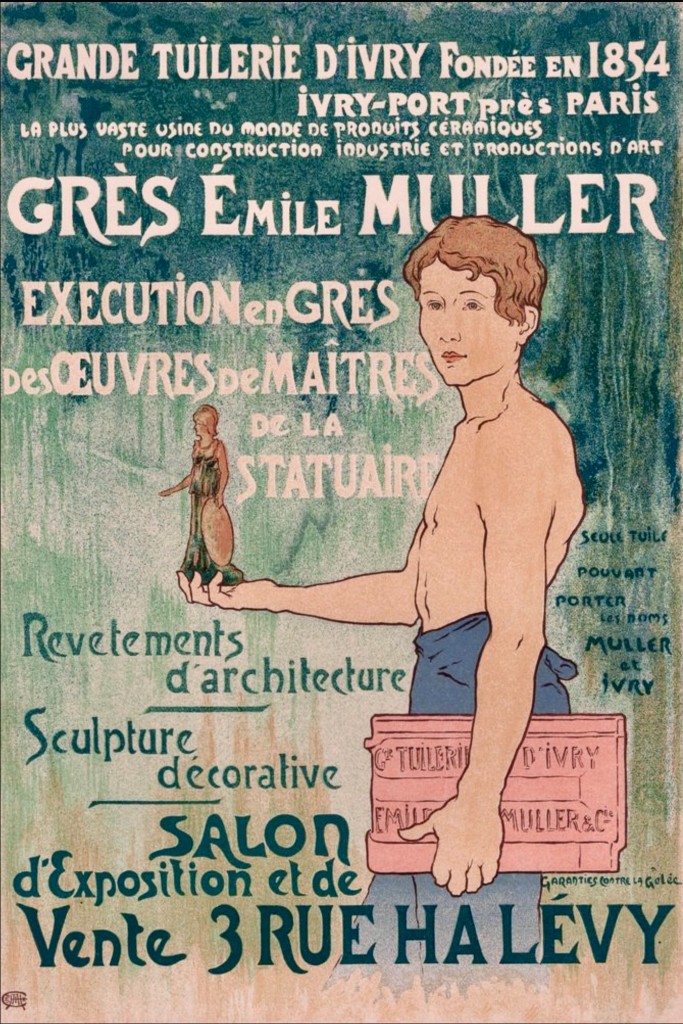
That debut rested on a ceramic body Muller had perfected in 1884: grès Muller, developed for architectural elements and, from the outset, for reproducing sculpture. His son Louis Muller, known as Louis d’Émile (1855–1921), succeeded him in 1889 and continued the firm as Émile Muller et Cie. Under Louis, sculptural editions became a program with few parallels among ceramic manufactories. The roster of artists whose models were issued in Muller stoneware numbers several dozen, among them Dalou, Frémiet, Alexandre Charpentier, Camille Claudel, Constantin Meunier, Eugène Grasset, Henri de Toulouse-Lautrec, Philippe Wolfers, and Hector Guimard. Sculptural editions typically bear the manufactory’s incised “E. Muller” signature beside the artist’s own, with “reproduction interdite” and a model number impressed on the base. Charpentier advertised the collaboration in a lithographed poster whose slogan was exact: “Exécution en grès des œuvres des maîtres de la statuaire.”
Most of the firm’s Art Nouveau ceramics were produced under Louis, and the years around 1900 marked its summit. Five separate works were then operating at Ivry, employing three to four hundred people, and the house described itself — with little exaggeration — as the world’s largest ceramic works for construction, industry, and art. At the Exposition Universelle of 1900, the firm won a grand prix, while its grès occupied the fair’s front door in the most literal sense. The Frise du Travail, modeled by Anatole Guillot (1865–1911) and fired at Ivry, encircled the base of René Binet’s monumental entrance gate. Depicting the exposition’s own workers, it has been described as the only monument to labor actually realized under the Third Republic. After the fair Louis Muller re-erected the frieze in the factory courtyard; a surviving section now stands in the Parc du Moulin at Breuillet.
The original firm came to an abrupt end in February 1908, when it was liquidated and its works, models, and name were acquired by Camille Bériot. Bériot continued production under the Muller name, as did later corporate successors through the interwar period; the Ivry works survived under changing identities until the late 1960s, when the site was sold and its buildings demolished. The 1908 liquidation is therefore the boundary observed here. Objects made at Ivry afterward belong to a successor enterprise operating under the purchased Muller name, even where the models, marks, and grès persisted. This distinction is especially pertinent to the collection’s tortoise foot-warmer of about 1915: a Muller-marked object produced seven years after Émile Muller et Cie had been liquidated, and a vivid demonstration that the manufactory’s material legacy outlived the firm itself.
The manufactory’s place in the Bestiaire rests on these sculptural editions, represented here by three double-signed works. Jean-Désiré Ringel d’Illzach’s porcupine vide-poche hollows the animal itself into a vessel; sculptor and manufacturer were both Alsatian-born, and both names are cut into the clay. Its flooding turquoise recalls the house color that roofed the exhibition palaces of 1889 and saturates Ringel’s mask of Berlioz, the collaboration’s best-known product, now in the Musée d’Orsay. Alexandre Vibert (1847–1909), a pupil of Frémiet, sets a lizard stalking a beetle among rising blooms; the form was exhibited at the Société des Artistes Français in 1898. Pierre Roche’s tortoise foot-warmer, a patinated bronze chassis fitted with two interchangeable grès shells, belongs to a documented Muller series of animal foot-warmers designed by named sculptors; published parallels include the crouching cats of the Swiss sculptor Jacques Vibert (1872–1942). In the collection, Ringel and Roche are each represented through editions by three different ceramic houses; Muller is the one manufacturer they share. Across these collaborations, the animal remains the sculptor’s creature; the manufactory gives it body, glaze, and fire.
Literature
Arthur, Paul. French Art Nouveau Ceramics: An Illustrated Dictionary. Paris: Éditions Norma, 2015. The Émile Muller and Louis Muller entries, p. 287 f., supply the chronology followed here, the roster of edited sculptors, and the marks.
Duncan, Alastair. The Paris Salons, 1895–1914. Vol. IV: Ceramics and Glass. Woodbridge: Antique Collectors’ Club, 1998. The Salon ceramics of the Muller circle; the collection’s Vibert vase form is illustrated at p. 356.
“La Grande Tuilerie d’Ivry.” Article series in five parts. Le Cercle Guimard, lecercleguimard.fr, 2020. The fullest modern account of the works, illustrated from the firm’s own catalogues; parts three and four treat Hector Guimard’s model editions. The later portion of each article is reserved to members.
Hamon, Françoise. “Muller, réformateur et industriel.” In Le Paris des Centraliens, edited by Jean-François Belhoste. Paris: Action artistique de la Ville de Paris, 2004, p. 190. The founder as engineer, teacher and reformer.
Mercadier, Catherine, and Michèle Rault. La Grande Tuilerie d’Ivry, 1854–1969: le beau et l’utile. Ivry-sur-Seine: Ville d’Ivry, 2009. The study from the Ivry municipal archives, published for the 2009 exhibition on the works.
Slitine, Florence. “Céramique d’architecture et d’art: la maison Muller à Ivry (1854–1908).” Sèvres. Revue de la Société des Amis du Musée national de Céramique, no. 20, 2011. The principal scholarly article on the firm; its very span ends the house at the liquidation of 1908, the boundary adopted here.