Firm/Maker Record
Elchinger et Fils
A multigenerational Soufflenheim manufacture, Elchinger et Fils transformed traditional Alsatian pottery into an internationally informed Art Nouveau art ceramic under Léon Elchinger, whose technical mastery supported ambitious collaborations with sculptors including Jean-Désiré Ringel d’Illzach.
Historical Note
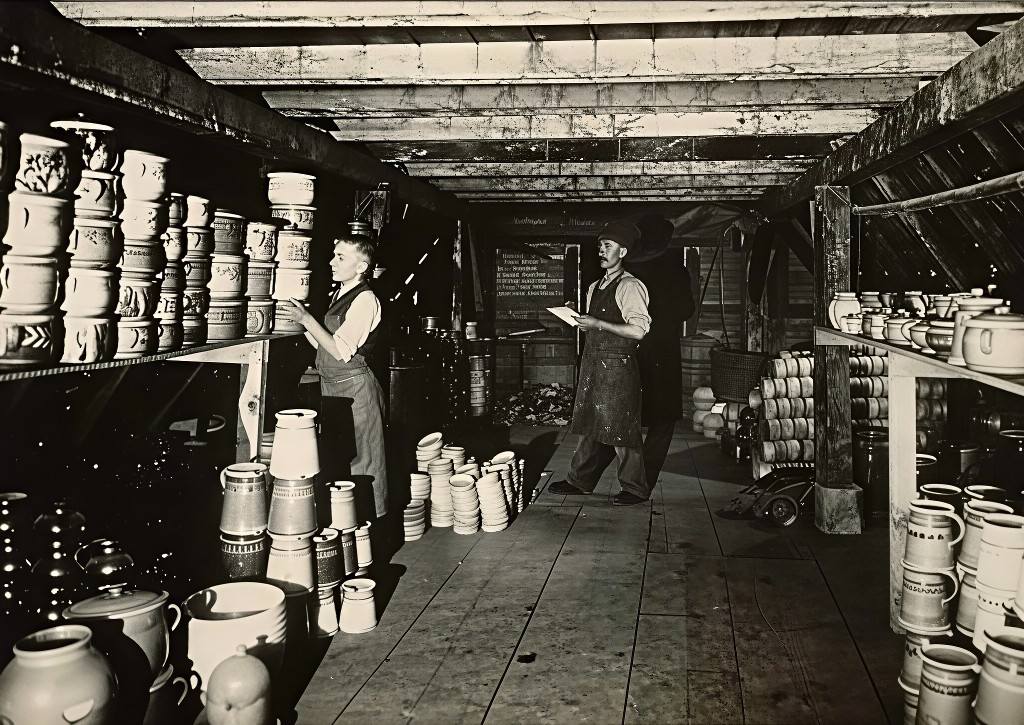
The manufacture originated in a tileworks established by Michel Elchinger around 1792 and was formally founded as a pottery in 1834 by his son Wendelin Elchinger (1809–1895), who converted the tilery to culinary ware. Wendelin’s son Philippe (1842–1906) succeeded him and from about 1870 expanded the workshop into a small industrial manufacture, modernizing its equipment and developing architectural ceramics, refractory bricks, tiles, garden ornaments and horticultural wares alongside the traditional culinary pottery. By the 1890s the firm was operating as Philippe Elchinger et Fils — also recorded during the period of German administration as Philippe Elchinger und Söhne — and was positioned to establish a distinct art-pottery division.
That transformation was led by Philippe’s son Victor Léon Elchinger, born at Soufflenheim on 3 December 1871 into an Alsace newly annexed by the German Empire and dead there on 8 February 1942. His training crossed the border repeatedly. In 1889 he was at the École des Beaux-Arts in Nancy; in 1890 he went to Germany, to the technical ceramics school at Höhr-Grenzhausen; he then made a compagnon’s tour de France until 1892, and in 1892–93 attended the École des Arts décoratifs in Strasbourg, where Anton Seder entrusted him with the ceramic decoration of the new school’s own façade — his first work, executed at twenty-one and still in place. He also studied at Villeroy & Boch in Mettlach, in England at Wedgwood, and in 1897 at the Zsolnay manufacture in Hungary, where he learned the flamed and iridescent glazes that became his specialty. He entered the family pottery in 1893, joined the circle of Saint-Léonard around Charles Spindler, and took over the direction of the works on his father’s death in 1906 — although he had begun making art pottery well before that. He showed at the Paris international exhibition of 1900 and at Turin in 1902.
The art pottery he developed encompassed slip-decorated earthenware, flamed and lustred stoneware, and highly modeled sculptural vessels. His work united the forms and motifs of Alsatian vernacular pottery with Japonisme, the Arts and Crafts movement, Jugendstil and the ceramic example of Jean Carriès. The combination is not incidental to the place: a village potter’s son trained in Nancy and the Rhineland, working under German administration for a French-speaking clientele, was formed by exactly the cross-border condition that his region imposed on him.
The most ambitious products of the manufacture were its sculptural pièces de forme, for which Léon opened the workshop and its technical resources to artists including Alfred Marzolff and Jean-Désiré Ringel d’Illzach. Ringel returned to Strasbourg around 1905 and collaborated actively with Elchinger on a small group of extraordinary modeled stonewares, among them the Batrachian Chimera and the Owl-Chimera, and a vase carrying four expressive female faces — two laughing back to back, two screaming, their hair and bodies dissolving into the body of the pot — signed only “Soufflenheim” with a model number. In these works Elchinger’s role as editor should not be understood as merely commercial: whatever the exact division of modeling labor, the manufacture was responsible for realizing the sculpture in ceramic, applying its complex glaze and successfully firing a large and technically demanding form. It is the same arrangement the Bestiaire documents for Bigot with Pierre Roche, for Jeanneney with Prud’homme and for Lachenal with de Manneville, and the resulting works represent a genuine partnership between Ringel’s strange Symbolist imagination and Elchinger’s command of clay, glaze and fire.
The partnership also reached the street. In 1905 Ringel and Elchinger made the Dauphin et le Singe for the Orangerie in Strasbourg, and in 1906 Elchinger produced the Gockelsbad fountain at Haguenau, so that the same animal imagination that yielded the chimeras was carried into public fountains in glazed ceramic at architectural scale. That range is what gives the manufacture its place here. Elchinger’s animals run from a fabulous creature modeled by a sculptor and fired as a unique piece, through the fable subjects of a civic fountain, to the beasts of the Alsatian vernacular repertory the works had made for generations — and all of them depended on a technical command of flamed and lustred glaze acquired at Zsolnay and turned to purposes no Hungarian model anticipated.
After the First World War, the manufacture resumed production in an Art Deco idiom, while Léon increasingly undertook religious sculpture and architectural commissions; he was also active in Alsatian political life, sitting as conseiller général, and was the father of Léon-Arthur Elchinger, later bishop of Strasbourg. His son Fernand Elchinger was involved in production from about 1930 and assumed leadership in 1936, later modernizing and industrializing the business, which became especially successful for its restrained, often two-colored ceramics during the 1950s and 1960s. Subsequent generations continued the family enterprise until the manufacture permanently closed on 30 June 2016.
Literature
Arthur, Paul. French Art Nouveau Ceramics: An Illustrated Dictionary. Paris: Éditions Norma, 2015.
L’Art nouveau dans le Rhin supérieur: Créer et vivre sans frontières. Exhibition catalogue. Karlsruhe: Badisches Landesmuseum and Braun, 2009. The cross-border framing that Elchinger’s formation exemplifies.
Elchinger, Marc. “Léon Elchinger, céramiste de Soufflenheim.” Annuaire de la Société d’histoire et d’archéologie du Ried-Nord, 1992, pp. 101–106. A family account, by the descendant who later co-authored the 2016 monograph.
Kiwior, Julien, and Walter Kiwior. “Léon Elchinger, un céramiste alsacien aux influences européennes.” La Revue de la BNU, no. 19, 2019, pp. 94–101.
Legendre, Jean-Pierre, and Jean Maire. “Les marques sur céramiques de l’atelier de Léon Elchinger (1871–1942).” Cahiers alsaciens d’archéologie, d’art et d’histoire, vol. 40, 1997. The reference for the marks, and the place to test a piece signed only “Soufflenheim” with a number.
Syring, Sophie-Élisabeth, Rainer Syring, and Marc Elchinger. Elchinger céramistes, 1890–1960. Sarreguemines: Éditions des Musées de Sarreguemines, 2016. The monograph, reproducing some four hundred pieces, with a section on the ceramic sculpture made for artists including Marzolff and Ringel d’Illzach. It appeared in the year the firm closed.