Firm/Maker Record
A. Bigot et Cie
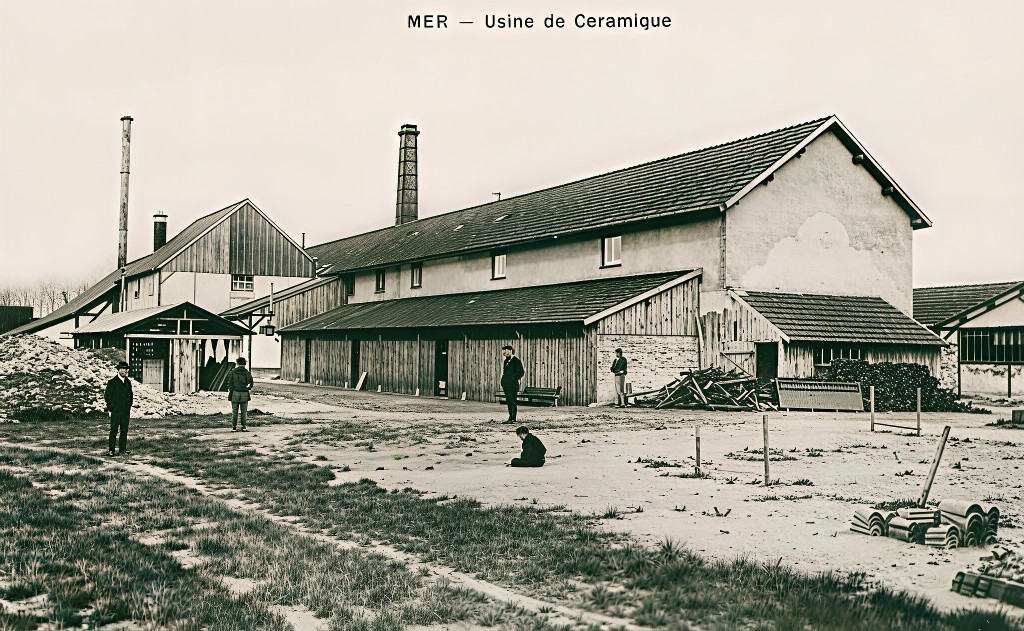
The manufactory Bigot built in his native Mer translated the models of many leading sculptors into fired stoneware, while an atelier within the firm developed an extensive bestiary of its own, although the modelers of most house designs remain unidentified.
Historical Note
The company grew from the ceramic works Alexandre Bigot established at Aulnay, a hamlet of his native commune of Mer, in 1894. On April 14, 1897, increasing demand prompted him to organize the enterprise formally as A. Bigot et Cie. Production remained at Aulnay, while administration and sales were centered in Paris; by December 1897 the company maintained its headquarters and showroom at 13, rue des Petites-Écuries. The scale was considerable for an art-ceramic enterprise: the Aulnay complex eventually encompassed roughly 1,500 square meters of workshops, ten large kilns and, at its peak around 1900, approximately 150 employees.
The manufactory was built around high-fired glazed stoneware, particularly the grès flammés that became one of the characteristic materials of Art Nouveau architecture. Its catalogues offered both serial and bespoke production: tiles, roof elements, chimney pots, fireplaces, columns, lintels, balustrades and façade sculpture appeared beside vases, dishes, decorative objects and other ceramics for interiors. A surviving 1902 catalogue records this enormous range, while a second catalogue of 1908 concentrated on fireplaces and stoves. The combination of standardized units with specially commissioned sculpture allowed Bigot to operate simultaneously as manufacturer, laboratory and artistic editor.
Its great distinction was collaboration. Rather than impose a single house style, A. Bigot et Cie adapted its ceramic technology to the designs of others. Guimard employed Bigot stoneware at the Castel Béranger; Henri Sauvage used it at the Villa Majorelle; Jules Lavirotte made it an integral element of some of the most spectacular ceramic façades in Paris; and other commissions involved Anatole de Baudot, Auguste Perret, André Arfvidson and architects outside France. Sculptors including Pierre Roche, Paul Jouve, Jean-Baptiste Larrivé, Alfred-Jean Halou, Camille Alaphilippe and Antoine Bourdelle supplied models that the factory translated into fired ceramic. The result could be unique architectural sculpture, limited editions or models subsequently absorbed into the commercial catalogue.
Animals formed an unusually rich part of this collaborative production. Roche’s frogs, salamanders, tadpoles and pond life — models of 1897, the founding year itself, and so among the firm’s very first campaign of editions; Jouve’s monumental beasts for the 1900 Exposition; animal sculptures associated with Halou, Annie Avog, Raymond Bigot and others; and a broader factory repertory of frogs, mice, ermines, birds, salamanders and fantastic creatures made the manufactory an important contributor to the Art Nouveau bestiary. Where a named sculptor is documented, authorship should be divided accordingly—model by the sculptor, ceramic realization by Bigot. Other animal designs survive simply under the Bigot name, but the factory employed designers and modelers of its own, so they should not automatically be assigned to Alexandre Bigot’s personal hand. The distinction is particularly important for a collection in which Bigot appears repeatedly as editor and ceramist rather than sculptor.
The Exposition Universelle of 1900 marked the firm’s public apogee. Its pavilion, designed by Jules Lavirotte, displayed architectural stoneware on a monumental scale, while Bigot also executed Paul Jouve’s animal frieze for René Binet’s entrance to the exposition; Bigot received a Grand Prix and other honors. By 1913, however, surviving records show changes in the company’s organization and name, including Bigot, Daligault & Cie and later Bigot, Bouclet, Fritsch-Lang et Cie, with Camille Alaphilippe serving as artistic director. The underlying enterprise did not simply continue unchanged: in 1914 the company was dissolved amid financial difficulties and the disruption of war. The Aulnay works themselves survived under new ownership, becoming Grès de la Beauce under the architect Jean-Marie Louis Hardion and continuing principally with utilitarian and sanitary stoneware until 1939.
Literature
Hélène Bédague, Alexandre Bigot, chimiste & céramiste. Paris: Éditions Louvre Victoire, 2016. The essential monograph and the principal source for the corporate, technical and artistic history of A. Bigot et Cie.
Paul Arthur, French Art Nouveau Ceramics: An Illustrated Dictionary. Paris: Éditions Norma, 2015, pp. 56–59. Valuable for the firm’s sculptural collaborators, animal models, marks and changes in ownership and management during its final years.
Camille Napolitano, La maison aux majoliques de la rue Campagne-Première: L’immeuble d’ateliers pour artistes d’André-Louis Arfvidson, prototype d’un modèle architectural moderne. Master 2 research thesis, École pratique des hautes études, 2018, especially pp. 67–74. An important archival study of the Aulnay works, the April 1897 creation of A. Bigot et Cie, its Paris administration, catalogues and 1914 dissolution.
Anne Maillard, La Céramique architecturale à travers les catalogues de fabricants en France, 1840–1940. Paris: Septima, 1999. Particularly useful for understanding Bigot’s serial architectural production and the wider French market in which it operated.
A. Bigot & Cie, Les Grès de Bigot. Mer and Paris, 1902; and Grès de Bigot: Cheminées et poêles à Bon Marché, 1908. The two surviving period sales catalogues are indispensable primary documents for the actual range and commercial organization of the manufactory.