Artist Dossier
Pierre Roche
A chemist and inventor turned sculptor, Roche supplied pond life — frogs, salamanders, tadpoles, marsh water — to Bigot, Dammouse and Émile Muller alike, which makes him the collection’s clearest case of one hand read through three different ceramists.
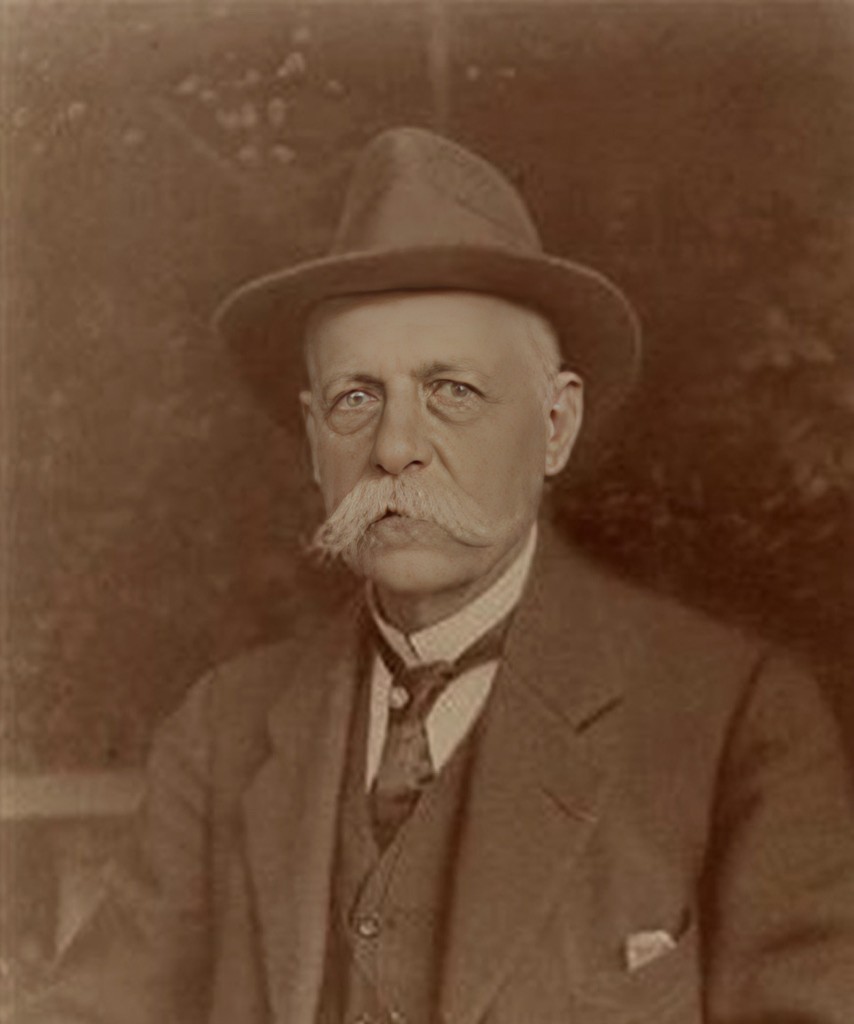
Biographical Note
Pierre Roche was the professional name of Pierre Henry Fernand Massignon, born in Paris on 2 August 1855 and died there on 18 January 1922. He came to art late and sideways, having begun with chemistry and medicine, and only then turning to painting: he studied at the Académie Julian from 1873 to 1878 under Alfred Roll, exhibited at the Salon from 1884, and attempted sculpture for the first time in 1888 in order to compete for a monument to Danton, which brought him the encouragement of Jules Dalou. Paul Arthur adds Auguste Rodin to his teachers and records his friendship with J.-K. Huysmans. He was the father of the orientalist Louis Massignon, whom he modeled as a child in 1890 and who would later publish the catalogue of his father’s prints.
The scientific beginning never left him, and it is the key to his ceramics. Roche was an inventor as much as an artist. In 1895 he devised gypsography, a method of engraving into plaster that yields a print in relief with Japoniste effects, and he published his own account of it the following year; when the fragile plaster matrix proved to limit editions, he replaced it with a metal one and called the result gypsotypie, using it for the book Roger Marx devoted to Loïe Fuller in 1904. He also patented a refrigerating process for a snow sculpture made in 1896 for the visit of Tsar Nicholas II, designed a protective mask for motorists, pursued X-ray photography to the point of producing a work of anatomy, and lectured the Olympic committee on art and sport in 1906. A man who thought in processes was the natural collaborator for the ceramic chemists of his generation.
Roche’s importance to Art Nouveau ceramics lies above all in his work with Alexandre Bigot, but it did not stop there. He supplied models to Albert-Louis Dammouse, to Émile Muller — the most important architectural and sculptural stoneware manufacturer of the period — to Janin and Guérineau, Loebnitz and the Mougin frères, briefly to Émile Decœur, and possibly to the Atelier de Glatigny. That range is what makes him so useful here. In the Bestiaire a single sculptor’s models appear realized by three different houses — Bigot, Dammouse and Muller — which is an unusually complete demonstration of the system on which Art Nouveau ceramic sculpture depended, in which designer, modeler, ceramic chemist and manufactory operated as distinct but interdependent forces. The same arrangement produced the collection’s Bigot-edited Alaphilippe, its Lachenal-edited de Manneville and its Jeanneney-edited Prud’homme; Roche is the case where the editors can be compared against one another on the same hand.
His subject, more than any other, was the pond. Frogs, salamanders, tadpoles and marsh surfaces are rendered as shallow circular plates, coupes and plaques in which the water itself becomes the ceramic field. Bédague reproduces a description of Roche dreaming of round hollow plates like the surface of a marsh, with drops of water and a frog climbing at the edge — a vision that Bigot’s technical command made possible. Almost all of these pond plates were editions of Bigot’s; the lizard plate fired by Dammouse is a rarity, long believed to survive in a single example until a second came to light. The wall plaque with salamander designed by Roche and made by Bigot around 1895–97, now in the Metropolitan Museum of Art, shows the vocabulary at its purest: a creature emerging from a glazed, bubbling ground in which animal, water, mud and ceramic surface become almost inseparable. This is precisely why Roche matters to the Bestiaire. His animals are not applied decoration but events within the ceramic body, where glaze, relief and creature fuse into a single organic field.
Behind that fusion lay patient observation. Roche studied his models in nature and drew them from every angle before transferring them to a gypsography, a plaquette or a medal, and while his predilection was for insects, birds and aquatic fauna he did not confine himself to them; his plaquette Tête de tigre was worked up from a photograph of a dead cat kept in his own documentation, which Paul Vitry described as a curious thing in which a flayed cat’s head takes on the airs of a great wild beast. The habit of looking hard at a creature and then translating it through whatever process would carry it best — plaster, metal, bronze, stoneware, printed relief — is what unites a career that otherwise refuses to settle in any one medium.
Literature
Arthur, Paul. French Art Nouveau Ceramics: An Illustrated Dictionary. Paris: Éditions Norma, 2015, p. 327. The Roche entry, and the source for his training, his friendship with Huysmans and the full range of manufactories that executed his models.
Bédague, Hélène. Alexandre Bigot: Chimiste et céramiste. Paris: Éditions Louvre Victoire, 2016, pp. 146–159. The fullest account of the Roche–Bigot partnership, with the pond plates and coupes extensively illustrated.
Fonds Pierre Roche, ODO 2010-1, nos. 1–106, 1892–1922. Archives of the musée d’Orsay, with a detailed analytical inventory published by the museum. Covers the decorative art, the ornamental sculpture and objets d’art, the gypsographies, Loïe Fuller, and the presentation of his work in exhibitions between 1901 and 1907.
Massignon, Louis. Estampes modelées et églomisations de Pierre Roche: catalogue de ces œuvres. Paris: Nouvelle Revue critique, 1935. The catalogue of the prints, compiled by the artist’s son, with an introduction and two of Roche’s own articles in appendix.
Pélissier, Claire. “L’estampe de sculpteur: Pierre Roche (1855–1922) et l’invention de la gypsographie.” Nouvelles de l’Estampe, no. 214, October–November 2007, pp. 16–28. Drawn from her unpublished thesis of 2005, and the principal modern study of the artist.
Roche, Pierre. “La Gypsographie et son avenir.” Revue encyclopédique, no. 154, 15 August 1896. Roche’s own statement of the process.
Vitry, Paul. “Pierre Roche.” Art et décoration, 1 January 1904. The contemporary monographic account, written at the height of his reputation.