Artist Dossier
Alfred Renoleau
A Charentais hairdresser converted by the sight of Palissy’s work, Renoleau taught himself to pot in an attic kiln and built at Angoulême a Palissy revival of his own, where crabs, frogs, lizards and dragons rise from the vessel in high relief.
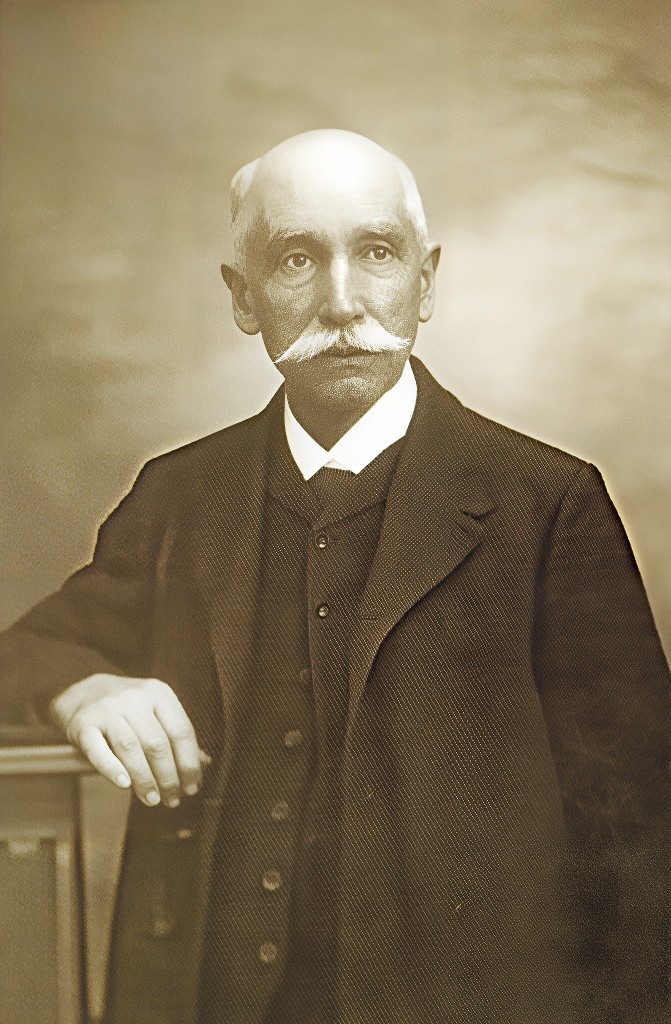
Biographical Note
Alfred Renoleau was one of the most versatile French ceramists of the late nineteenth and early twentieth centuries. The son of a barber, he followed his father’s trade in Mansle for about a decade. A ceramics exhibition seen at Bordeaux around 1878 introduced him to the work of Bernard Palissy and settled the rest of his life: he built a kiln in his own attic and fired at night, until a fire drove the operation out of town to the Moulin des Lacunes. In 1888 he abandoned hairdressing to work at the Polakowski tileworks in Roumazières, engaged to make Palissy-style dishes for the firm’s best customers, and there gained practical command of ceramic manufacture under the modeller Sylvestre Bourigeaud. He worked for a time in the Paris atelier of Georges Pull, the leading Palissy revivalist of the previous generation, before moving to Angoulême, where in 1891 joined the painter François Goras in establishing Renoleau, Goras & Company. After withdrawing from the partnership in 1895, Renoleau founded his own manufactory, settling permanently in 1897 beside the Anguienne, where he constructed kilns for both earthenware and high-fired stoneware.
Renoleau first achieved distinction through naturalistic earthenware inspired by the sixteenth-century potter Bernard Palissy. His platters, plaques and vessels teem with crabs, lobsters, fish, eels, frogs, lizards and snakes modeled in relief against rippling grounds of leaves, shells and aquatic vegetation — largely the reptiles, batrachians, river fish and crayfish of his own Charente, set beside shells and creatures of the coast. Yet his finest works avoid the appearance of specimens arranged for inspection. Irregular contours, overlapping bodies and glazes that pool in the modeled depressions create convincing habitats charged with moisture and movement. Animals appear to emerge from tidal pools, marshes and riverbanks, making the environment itself as important as the individual creature.
Beginning around 1905, Renoleau increasingly explored grès and the fluid vocabulary of Art Nouveau. Flamed, iridescent and crystalline glazes produced shifting passages of green, blue, ocher and red, while modeled animals became structural components of the vessel. A frog climbs the swelling body of a vase; a lizard coils around its neck like a living handle; dragons and other fantastical creatures emerge from folds of clay and streams of glaze. Renoleau’s animals are therefore rarely added as incidental ornament. Their limbs, tails and bodies redirect the silhouette and generate the object’s movement, continuing the vitality of his Palissy-inspired work in a more abstract and sculptural language.
Japonisme also played an important role in Renoleau’s evolving treatment of nature. Its influence can be detected early in asymmetrical compositions, abrupt cropping and the displacement of a single animal from the center of a plate. It became especially conspicuous in his more theatrical sculptural ceramics of the early twentieth century, in which fish rise from stylized waves and the animal itself determines the form and function of the vessel. Rather than merely decorating a vase with Japanese motifs, Renoleau absorbed the Japanese ideal of unified design: creature, water, contour and empty space become parts of a single composition. Some of these works have traditionally been dated to the 1890s, but in the absence of firm documentary evidence, a broader early-twentieth-century dating is more responsible.
Renoleau continued to adapt his production through the 1910s and 1920s, introducing more regular silhouettes, painted ornament and crystalline or metallic effects suited to the emerging Art Deco taste. The workshop also took outside commissions, among them the “Marquise de Sévigné” decor made to order for the Rouzaud chocolate house at Royat, examples of which are now in the Musée d’Angoulême. Renoleau was named Officier de l’Instruction publique and, on 10 February 1927, chevalier of the Légion d’honneur. His remarkable range—from Palissy revival naturalism and Japonisme to Art Nouveau stoneware and later decorative faience—did not result in an incoherent career. Animals and their environments remained the connecting thread. Renoleau repeatedly moved from specimen to habitat and from applied decoration to integrated form, changing artistic languages without surrendering his own fascination with living nature. After his death in Angoulême in 1930, the manufactory passed to his nephew and adopted son, Joseph Roullet, his associate since 1900, and continued under the name Roullet-Renoleau.
Literature
Yvette Renaud, Alfred Renoleau : céramiste charentais, preface by Béatrice Pannequin, La Couronne, Centre départemental de documentation pédagogique de la Charente, 2004, 247 pp. ISBN 978-2-903770-46-4. The monograph; includes the principal marks and signatures.
Marshall P. Katz and Robert Lehr, Palissy Ware: Nineteenth-Century French Ceramists from Avisseau to Renoleau, London and Atlantic Highlands, NJ, Athlone Press, 1996, 192 pp. Renoleau is the closing figure of the survey.
Marshall P. Katz, Nineteenth-Century French Followers of Palissy, 1994.