Artist Dossier
Prud’homme
An unidentified sculptor active in Puisaye during the early twentieth century, Prud’homme collaborated with Paul Jeanneney on expressive, often zoomorphic stoneware before producing ceramics in his own atelier.
Biographical Note
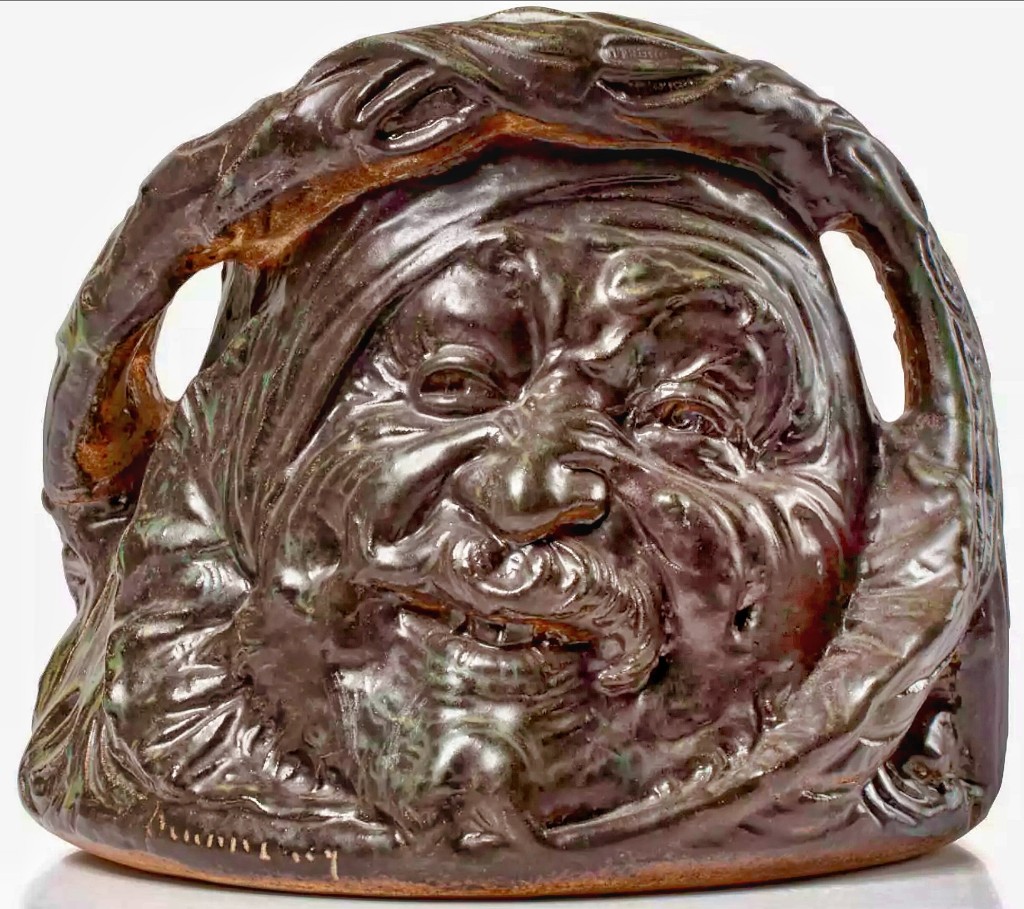
The identity of the sculptor who signed his work “Prudhomme” or “Prud’homme” remains unresolved. Around 1900–1904 he collaborated closely with the ceramist Paul Jeanneney at Saint-Amand-en-Puisaye, modeling both wheel-thrown vessels and figural works that Jeanneney glazed and fired. Their documented collaborations include Le Défi, Collerette, Moine, several small rustic vases of Japonist inspiration, and a grotesque vase known in at least two examples; to these may be added a stoneware Balzac of about 1900 inscribed Jeanneney above and Prud’homme at the side, and a small dented truncated-conical vase stamped with dragonflies and butterflies under ochre, beige and brown enamels. That last piece carries the inscription that says more about the partnership than any commentary can: “Modelé par le petit père Prudhomme, émaillé par le gros père Jeanneney” — modeled by little Father Prud’homme, glazed by big Father Jeanneney. The wording suggests an affectionate workshop relationship and may refer either to their respective physical stature or to Jeanneney’s position as the more experienced ceramist and mentor. It is also, so far as the collection’s holdings go, the period’s plainest statement of the division of labor between sculptor and editing ceramist — written on the object, by the two men, as a joke.
Prud’homme’s surviving ceramics show a sculptor’s command of modeled form rather than the practice of a conventional studio potter. His subjects range from expressive human heads rooted in the medievalizing, grotesque tradition associated with Jean Carriès to naturalistic animal ornament. The Arkebauer vessel is characteristic: its deliberately irregular body serves as a landscape over which a remarkably observed lizard stretches around the opening, its scales, limbs and tapering tail modeled in high relief, with a frog worked into the same field. It is incised on the base with both names, “Prudhomme” and “Jeanneney,” so that the piece belongs with the double-signed works that document the partnership rather than with the pieces attributed to the Jeanneney circle on the evidence of glaze alone.
By 1911, correspondence preserved at the Musée Galliera indicates that L. Prud’homme was producing stoneware in his own atelier and hoped to exhibit independently. A bust modeled by him was manufactured at Puisaye by Eugène Vauthier in 1914, extending his documented activity beyond the period of his collaboration with Jeanneney. Arthur rightly cautions that the work does not appear to be by the better-known sculptor and medallist Georges-Henri Prud’homme (1873–1947). An Albert Prudhomme who received a diploma from the École de Céramique de Sèvres in 1905 offers a possible lead, but no evidence presently establishes that he and the sculptor L. Prud’homme were the same person.
A note on the name. This catalogue writes Prud’homme, with the apostrophe, following the form on the piece that settled the question here; incised and inscribed forms are transcribed as they appear on the object, and both Prudhomme and Prud’homme occur. The salerooms are equally divided, and the inconsistency is the sculptor’s own as much as the trade’s.
Literature
Arthur, Paul. French Art Nouveau Ceramics: An Illustrated Dictionary. Paris: Éditions Norma, 2015, p. 273. The source for the Galliera correspondence of 1911, the Vauthier bust of 1914, and the caution against confusion with Georges-Henri Prud’homme.
Nesly, Emmanuel, and Bernard Nesly. Grès de Puisaye: de Jean Carriès à nos jours — Marques & signatures. Saint-Amand-en-Puisaye, 2026, pp. 70–71, illustrated. The reference work for Puisaye marks and signatures, and the natural place to test an unresolved one.