Artist Dossier
Pierre-Adrien Dalpayrat
Driven north from the Riviera by the earthquake of 1887, Dalpayrat opened at Bourg-la-Reine in 1889 and made the flowing copper red that bears his name the ground on which crows, crabs, starfish and stranger creatures take their shape.
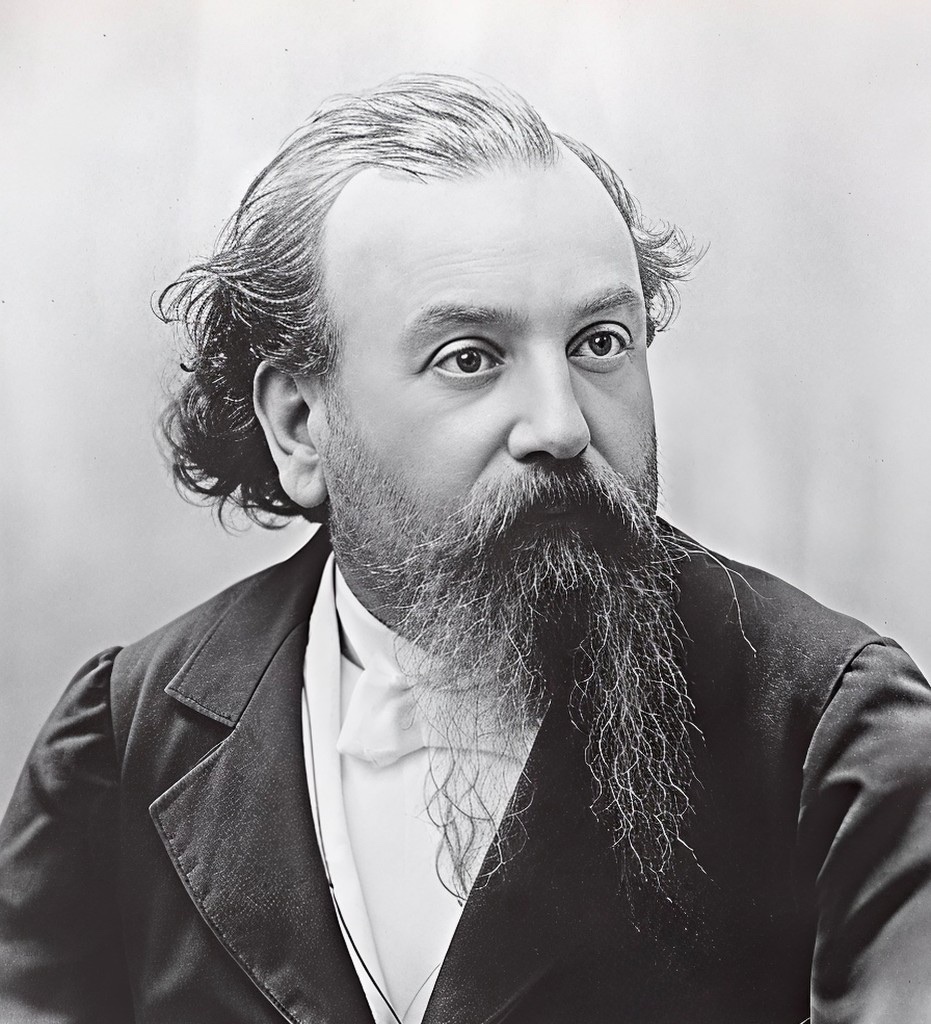
Biographical Note
Pierre-Adrien Dalpayrat was one of the commanding figures in the renewal of French ceramics at the end of the nineteenth century. Born into the great porcelain center of Limoges, he studied drawing and trained as a painter on porcelain before beginning an itinerant career that took him through several manufactories between 1867 and 1888. He worked at Jules Vieillard & Company in Bordeaux, returned periodically to Léon Sazerat in Limoges, and held positions with Ashwin at Valentine and Fouquet at Toulouse, and at Menton and Monte Carlo, where he directed the decorating workshop of the Poterie de Monaco. The Riviera earthquake of February 1887 drove him out of the south; he returned to Sazerat at Limoges long enough to raise the capital for a workshop of his own. These experiences gave him an unusually broad command of earthenware, porcelain decoration and industrial ceramic production before he turned decisively to artistic stoneware.
Dalpayrat settled at Bourg-la-Reine, south of Paris, in 1889–90 and began the period on which his reputation rests. There he devoted himself to high-fired stoneware, developing forceful, often irregular vessels whose modeled surfaces and unpredictable glazes placed the material itself at the center of the work. From 1893 until 1901, Adèle Lesbros provided financial support for his costly technical experiments, and the firm operated as Dalpayrat & Lesbros. Dalpayrat also collaborated with sculptors and designers: Alphonse Voisin-Delacroix, briefly the Swedish sculptor Agnès de Frumerie, Jean Coulon from 1894, and Maurice Dufrêne. The silversmiths Ernest Cardeilhac and Keller mounted pieces in gilt bronze, and the work sold through Bing’s L’Art Nouveau and La Maison Moderne in Paris, Tiffany in New York and O’Brien & Son in Chicago. This collaborative structure allowed the workshop to move freely between functional vessels, independent sculpture, architectural ceramics and elaborate exhibition pieces.
His defining technical achievement was the celebrated rouge Dalpayrat, perfected during the early 1890s. It was not a uniform oxblood red but a complex, mutable surface created through copper-based glazes and carefully controlled firings. Deep crimson could break into violet, turquoise, moss green, amber, yellow or leaden gray, often within a single object. Glazes pooled in recesses, thinned across ridges and streamed down vessel walls, making every firing partly unpredictable. Dalpayrat used this chromatic volatility with unusual confidence: the glaze does not simply cover the form but appears to reveal geological, vegetal or bodily forces moving beneath its surface. His rounded gourds, folded mouths and asymmetric profiles consequently possess the visual weight of sculpture even when entirely unornamented. The red was unveiled publicly in 1892 at the Galerie Georges Petit, where he showed fifty stoneware pieces modeled by Voisin-Delacroix, and the success was immediate. Work of these years commonly carries his stamp of a burst pomegranate, the grenade éclatée.
Animals provided Dalpayrat and his collaborators with especially powerful vehicles for joining sculpture, vessel and glaze. Panthers climb around bowls; crabs and seaweed engulf swelling vessels; crows bend their heads in brooding isolation; monkeys, dragons and marine creatures twist themselves around inkwells, dishes and asymmetric containers. These animals are rarely polite additions to conventional forms. They seize, distort or determine the object, while the mottled glaze suggests feathers, shells, wet skin, decaying vegetation or primordial terrain. The brief collaboration with Voisin-Delacroix introduced a particularly intense Symbolist strain, in which human and animal bodies enact dreams, appetite, menace and psychological unease. The two men signed a contract in 1892 granting each other exclusivity for twelve years; it ran barely one, ending with the sculptor’s death on 2 April 1893 at thirty-six. Because Dalpayrat worked through collaborations and within a family workshop, the sculptural model and its ceramic realization must sometimes be credited separately; his particular genius lay in allowing the fire and glaze to complete—and often transform—the modeler’s conception.
Dalpayrat’s international standing was confirmed by a gold medal at the Paris Exposition Universelle of 1900 and his appointment that year as a chevalier of the Légion d’honneur. Financial and organizational difficulties nevertheless brought his own Bourg-la-Reine operation to an end in 1906, when he retired to Limoges, where he gave the rest of his life to painting and drawing. Members of his family, particularly his sons Albert and Adolphe, remained involved in ceramics and continued aspects of the Dalpayrat tradition after his withdrawal. His former house and workshop at Bourg-la-Reine now belong to the town and hold the musée Dalpayrat, with more than 120 of his pieces — the largest public presentation of his work. Dalpayrat’s achievement rests not only on the famous red associated with his name, but on his ability to make ceramic form, sculptural imagery and unstable color behave as a single living substance.
Literature
Arthur, Paul, and Étienne Tornier. Adrien Dalpayrat. Exhibition catalog. New York: Jason Jacques Gallery, 2016. 118 pp. Accompanied the Dalpayrat collection presented at TEFAF; biography by Arthur, essay by Tornier.
Dalpayrat, André. Pierre-Adrien Dalpayrat, céramiste de l’art nouveau. Sceaux: Éditions du musée de l’Île-de-France, 1999. ISBN 2-901437-12-5. A biography by a descendant, published by the museum nearest the Bourg-la-Reine workshop.
Duncan, Alastair. Paris Salons 1895–1914, vol. IV: Céramique et verre. Woodbridge: Antique Collectors’ Club, 1998, p. 100.
Makus, Horst, Helen Bieri, André Dalpayrat, Jean Girel, and Madeleine Strobel. Adrien Dalpayrat, 1844–1910: Céramique française de l’Art Nouveau — Art du feu. Stuttgart: Arnoldsche, 1998. 232 pp. ISBN 978-3-925369-56-8. The catalogue raisonné.
Tornier, Étienne, and Peter Marino. Adrien Dalpayrat: The Peter Marino Collection. London and New York: Phaidon, 2020.