Artist Dossier
Clément Massier
Trained in the family workshops at Vallauris and established on his own at Golfe-Juan in 1883, Massier made metallic luster medium in its own right, over which bats and other creatures move as though lit from within the glaze.
Biographical Note
Clément Massier was born into a dynasty of Vallauris potters whose roots in the local trade ran back to his great-grandfather Pierre Massier, who established it there before the Revolution. He entered his father Jacques Massier’s (1801–1871) workshop at about twelve, learning a craft still largely centered on the utilitarian pottery for which Vallauris had long been known. A decisive influence arrived in 1859, when Jacques engaged the Bolognese master-potter Gaetano Gandolfi, who stayed several years. Gandolfi brought techniques unfamiliar in the local workshops — plaster molding, more sophisticated methods of decorating glazed earthenware, and, the French literature holds, the metallic-oxide iridescent couvertes themselves. He trained both brothers, Clément and the elder Delphin, and Clément afterward regarded him as his master. The point is worth pressing, because it places the origin of the Massier lusters not in a laboratory discovery of the 1880s but in an Italian workshop tradition reaching back through Gubbio and Deruta to Hispano-Moresque Spain. This early encounter redirected Massier from inherited craft toward the idea of ceramics as an experimental artistic medium.
After his father’s death in 1871, Massier worked for a time with Delphin before establishing himself independently at Golfe-Juan in 1883. The siting was deliberate: the new works stood on the coast road linking Cannes, Nice and Monaco, within reach of the railway and of the wealthy winter clientele of the Riviera. Within a year he employed some hundred and twenty workers, and he opened outlets in the region, in Paris and abroad. What distinguishes him from many successful ceramic manufacturers of his generation is the extent to which he remained personally engaged with materials and firing. He was potter, glaze experimenter and artistic entrepreneur at once, continually testing ceramic bodies, metallic compounds and kiln conditions while drawing freely upon ancient Mediterranean, Islamic, Japanese and contemporary French sources. The commercial sophistication of his enterprise was considerable, but it served an artistic ambition: to move the Massier name decisively away from ordinary pottery and into the international world of céramique d’art.
That ambition reached its highest technical expression in metallic luster, a reduction effect that demanded control of the kiln atmosphere rather than merely of the palette, and that could not be dictated so much as guided. The arrival of Lucien Lévy in 1887 was catalytic: Lévy brought a painter’s eye and a fascination with Hispano-Moresque ceramics, was named directeur des Travaux d’Art in 1892, and from about that date signed ceramics jointly with Massier; Massier for his part supplied a mature command of clay, glaze, firing and production. Their achievement is best understood as collaboration rather than the invention of either man alone. Together they turned metallic reflection into an expressive substance — copper, violet, turquoise, blue, green and gold appearing to shift with the angle of the light. The turquoise luster ceramics shown at the Paris Exposition Universelle of 1889 won a gold medal, and Massier continued pursuing iridescent effects long after Lévy left Golfe-Juan in 1895. A signed Lévy-Dhurmer piece therefore postdates about 1892, which makes the signature a dating instrument as well as an attribution.
The Golfe-Juan works also functioned as a school, and its graduates became its rivals. Jean-Baptiste Gaziëllo, who has his own page in this archive, passed through the Massier orbit as a young decorator of lusterwares before opening his own fabrique at Vallauris in 1910. Dominique Zumbo, once Massier’s employee, pushed metallic lusters in new directions and, by the usual French account, took the gold medal at the Paris Exposition of 1900 away from his former master. A workshop capable of absorbing and then losing personalities of that force says something about the man who ran it: Massier presided over an operation large enough to be industrial without letting it settle into a house manner.
Massier’s relationship to animal imagery is correspondingly broader than that of a conventional animal sculptor. His name encompasses works designed or decorated by collaborators as well as ceramics for which no separate designer is known, and individual authorship within such a large workshop must therefore be approached with care. Yet the artistic environment he created made animals unusually fertile subjects. Birds could be dissolved into flashes of iridescence; fish and cephalopods could merge with watery glaze; bats and insects could emerge from darkness or become part of the vessel’s structure. In the finest Massier ceramics, the glaze does not merely color the animal — it supplies atmosphere, movement and sometimes the very illusion of life. This fusion of living form and mutable surface became one of the defining contributions of Golfe-Juan to Art Nouveau ceramics.
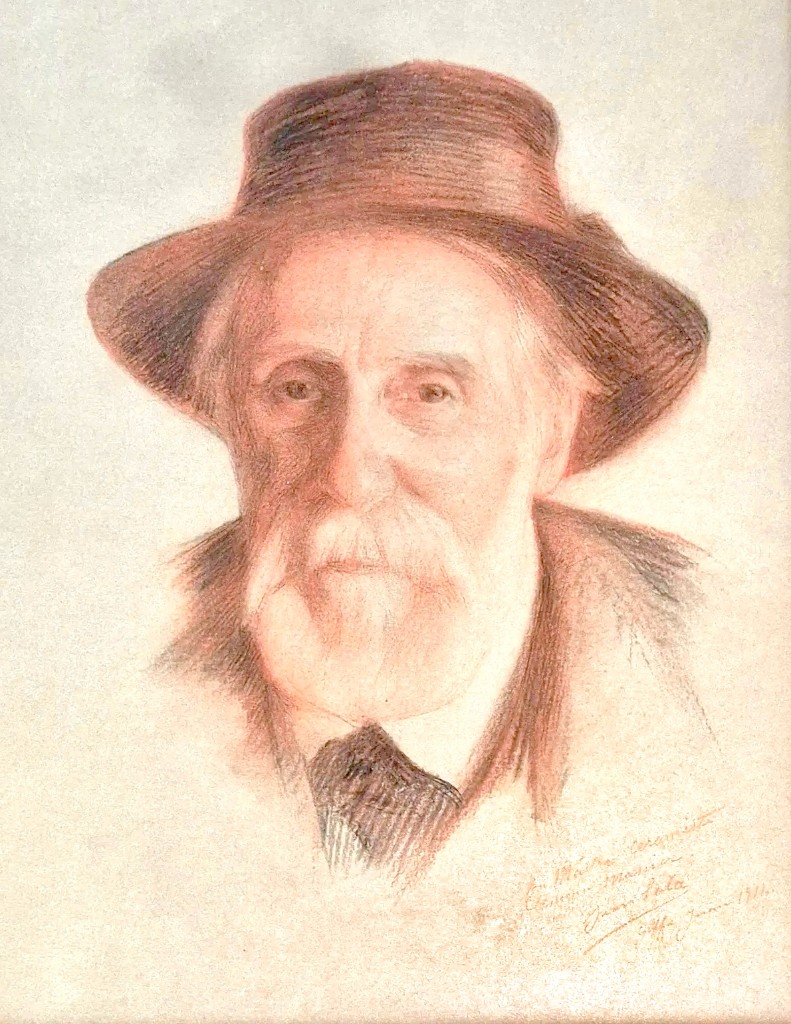
By the last years of his life the potter from Vallauris had become a public figure. The Catalan-born Paris portraitist Jean Sala, who showed at the Salon de la Société nationale des Beaux-Arts every year from 1893, drew him among a gallery of sitters otherwise made up of literary critics, politicians and the grande bourgeoisie — the measure of a reputation that had traveled from the Alpes-Maritimes to the capital. Massier died at Golfe-Juan on 14 March 1917. His daughters took over the works and reissued their father’s models, so that the pottery did not close with him; the cataloging consequence, discussed on the manufactory page, is that a Clément Massier model does not by itself establish a lifetime piece.
For the Bestiaire, his importance is difficult to overstate. No other ceramist is represented with comparable breadth, and across that extraordinary range the recurring constant is Massier’s conviction that ceramic color could be something more than surface decoration — that fire and glaze could become active participants in the representation of living nature.
Literature
Paul Arthur, French Art Nouveau Ceramics: An Illustrated Dictionary. Paris: Éditions Norma, 2015. Useful for situating Clément Massier, his collaborators and his animal ceramics within the wider development of French Art Nouveau.
Sandra Benadretti Pellard, Guy Decker, Jacques Massier and Cédric Massier, Les Massier: Côté cour, côté jardin. Milan: Silvana Editoriale, 2009. Particularly valuable for the family history and the relationships among the competing Massier enterprises.
Maryse Bottéro, Barbotines de la Côte d’Azur. Paris: Massin, 2002. The barbotine side of the Riviera production, and therefore the modeled animal forms that stand apart from the luster wares.
Jean and Paulette Declein, Céramiques Art Nouveau: Collection Jean et Paulette Declein. Vallauris: Château-Musée, 1995. Catalogue of a collection of some 130 Vallauris luster pieces given to the Château-Musée in 1994. Its technical chapter records that the descendants of Clément, Delphin and Jean-Baptiste Massier could supply no comparable working documents — the reason so much of what is known about how these lusters were made comes from outside the Massier houses.
Martin Eidelberg, Claire Cass and Ross Skoggard, Clément Massier: Master of Iridescence. New York: Jason Jacques Gallery Press, 2006. The principal English-language monograph devoted specifically to Clément Massier and the achievement of his iridescent ceramics; note that it dates his gold medal to 1900 rather than 1889, against the French consensus.
Dominique Forest and Karine Lacquemant, eds., Massier: L’introduction de la céramique artistique sur la Côte d’Azur. Exhibition catalogue, Musée Magnelli, Musée de la Céramique, Vallauris. Paris: Réunion des musées nationaux, 2000. The standard scholarly treatment of the Massier dynasty and its transformation of ceramics on the Côte d’Azur.
Anne Lajoix, L’Âge d’or de Vallauris. Paris: Éditions de l’Amateur, 1995. The Vallauris industry as a whole, within which the three Massier houses are best understood.
Mireille de Lassus and Dominique Lobstein, Jean Sala (1869–1918), catalogue raisonné. Paris: Éditions Illustria, 2010. For the portrait reproduced above, no. I·81; the catalogue is now continued in a digital edition.
Musée Magnelli, Musée de la Céramique, Vallauris, Massier: céramiques Art Nouveau. Exhibition catalogue, 1992. The earlier of the two Vallauris Massier exhibitions, eight years before the 2000 catalogue.
Pignates et poëlons: poterie culinaire de Vallauris. Paris: Réunion des musées nationaux, 1996. Bears on the luxury culinary wares of Massier’s later years.
Vallauris, de Massier à Picasso. L’Estampille / L’Objet d’art, hors-série no. 12, 1995. A useful short survey placing Massier at the head of the line that runs to the twentieth-century Vallauris studios.
Object Records
No linked object records yet.