Artist Dossier
Edmond Lachenal
Trained under Deck and master of the émail mat velouté, Lachenal is the most various animalier in the collection: frogs, bats, lizards, fish and cats by turns observed, comic, uncanny and monumental, with no single manner to define them.
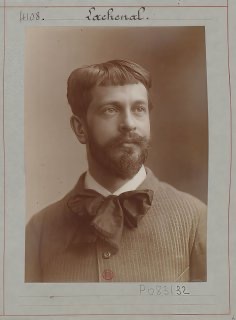
Biographical Note
Born Édouard Achille Lachenal, Edmond Lachenal rose from modest circumstances to become one of the most inventive and influential French ceramists of the Art Nouveau period. At twelve, in 1867, he was apprenticed to the Vaugirard potter Victor Rouvier; in 1870, the year he volunteered for the 127th battalion of the National Guard, he entered the workshop of Théodore Deck. He began there as a thrower before taking charge of the faience-painting workshop at eighteen, so that he learned the two halves of the trade in sequence rather than by choosing between them. His work was awarded an honorable mention at the Vienna Universal Exhibition of 1873, and he stayed with Deck about ten years. This unusually thorough training gave him a command of throwing, modeling, glaze and color that would later allow him to move freely between earthenware, stoneware and ceramic sculpture.
Lachenal established his own enterprise in 1881, working first at Malakoff and then at Châtillon-sous-Bagneux, where the workshop eventually occupied a hectare at 21 rue du Ponceau; nothing of it survives today. He did not set up alone. His wife Anna Le Cloarec, a ceramist from Guingamp whom he married in 1880, worked beside him from the beginning, and the enterprise was a joint one from its first day. His earliest independent ceramics remained close to Deck’s repertory, with brilliant polychrome decoration inspired by Iznik, Persian and other Islamic pottery. In 1884 he made the elaborate table service for Sarah Bernhardt, with fish and other creatures applied in relief, which brought him wide notice; it was seen again at the Exposition Universelle of 1889, where his display was awarded a gold medal, and a second gold medal followed at the Exposition of 1900. The Bernhardt commission demonstrated qualities that would remain central to his art: technical bravura, theatrical invention and a willingness to transform functional tableware into sculpture.
During the 1890s Lachenal moved increasingly toward stoneware and a more personal synthesis of Japonisme, naturalism and Art Nouveau. He developed the celebrated émail mat velouté, a soft, frosted or velvety surface achieved by dulling portions of a fired glaze — the accounts differ as to whether by hydrofluoric acid or by an electrolytic metallo-ceramic process, and he may well have used both. This permitted vivid color without conventional brilliance and made subtle modeling unusually legible. Irregular profiles, flowing outlines and decoration integrated into the vessel replaced the bordered ornament of his earlier Islamic-inspired work. Japanese art encouraged plunging viewpoints, asymmetry and the treatment of the vessel as a continuous pictorial field, while Lachenal’s own sculptural instincts pushed forms toward greater physical and psychological animation. His curiosity ran beyond his own kilns: in 1893 he worked with the manufactory of Keller & Guérin at Lunéville, experimenting there with metallic lustres.
Animals formed one of the richest and most distinctive strands of his production. Frogs dive into dishes or gather bodily to form an entire vase; lizards climb vessel necks and extend their tails around the body; bats spread across a Japanese lantern beneath moonlight and pine branches; fish support tureens; and a cat wrestling with a ball of yarn becomes both figure and container. Lachenal could move from close natural observation to comedy, fantasy and almost grotesque metamorphosis. His animals seldom remain applied ornaments: their legs, wings, tails and bodies determine the silhouette, create handles, interrupt rims or transform a useful object into a miniature habitat. The remarkable variety of these works helps explain why Lachenal is so extensively represented in the Bestiaire.
Lachenal was also an important interpreter of other sculptors’ models. His matte glazes proved particularly effective for ceramic sculpture, leading to collaborations from 1894 onward with Auguste Rodin, Max Blondat, André de Manneville and, most significantly, the Swedish sculptor Agnès de Frumerie — whom some accounts describe as his pupil rather than merely his collaborator. Between 1897 and 1908 de Frumerie and Lachenal produced ambitious Symbolist figures and reliefs in which her emotionally charged modeling was intensified by his stoneware bodies and colored glazes. His workshop also trained or employed major younger ceramists, above all Émile Decœur, an orphan whom he took in, trained and eventually took into partnership; the vases the two signed together between about 1901 and 1904 are the finest fruit of that association. His sons Jean-Jacques and Raoul learned the family craft and later continued separate branches of its production.
Around 1904 Lachenal increasingly withdrew from the daily direction of his pottery, entrusting the workshop to his wife and to Raoul, who in 1911 established his own grand-feu porcelain factory at Boulogne, while the father pursued theater, painting and pastel; the Châtillon operation was later moved to 22 rue de Verneuil in Paris. These later interests should not obscure the extraordinary concentration of invention achieved during the preceding two decades. Lachenal bridged Deck’s nineteenth-century coloristic tradition and the sculptural ceramics of Art Nouveau, while moving confidently between luxury commissions, experimental stoneware, collaborative sculpture and humorous domestic objects. Within the Bestiaire, his work is especially valuable because no single animal style defines it: the poetic, comic, uncanny and monumental coexist within one remarkably expansive ceramic imagination.
Literature
Arthur, Paul. French Art Nouveau Ceramics: An Illustrated Dictionary. Paris: Éditions Norma, 2015. The Lachenal entry places his work within the wider network of French Art Nouveau potters, sculptors, collaborators and ceramic manufactories.
Castelnau, Marie-Laure. “Edmond Lachenal: Pour l’amour des arabesques.” La Revue de la céramique et du verre, no. 229, November–December 2019, pp. 34–35. A concise modern account of his career, technical innovations, Japonisme and the three-handled vase in the Musée d’Orsay.
Eidelberg, Martin P., and Claire Cass. Edmond Lachenal & His Legacy. New York: Jason Jacques Gallery Press / Hudson Hills Press, 2007. The first comprehensive modern study of Lachenal, this richly illustrated exhibition catalogue also examines Théodore Deck, Agnès de Frumerie, Émile Decœur and Lachenal’s sons Jean-Jacques and Raoul.
Lajoix, Anne. “Auguste Rodin et les arts du feu.” Revue de l’Art, no. 116, 1997, pp. 76–88. Particularly useful for Lachenal’s execution of Rodin models in stoneware and for the wider relationship between modern sculpture and the private ceramic workshops. Available on Persée.