Artist Dossier
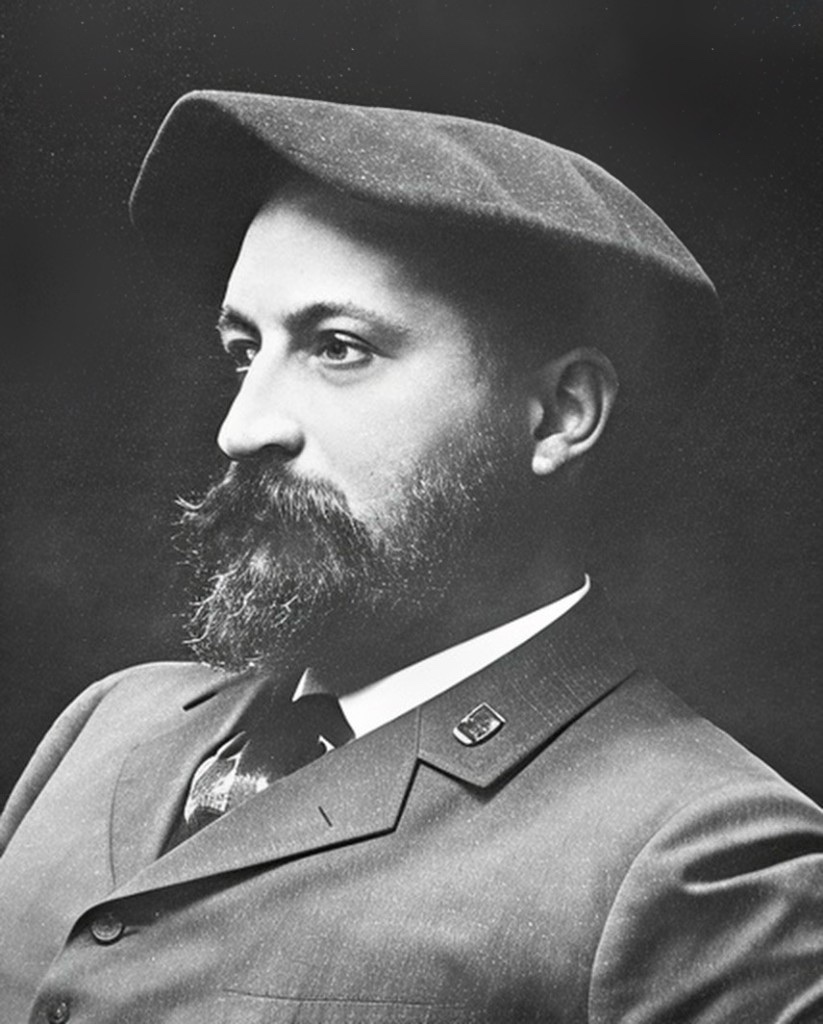
Paul Jeanneney
A collector who became a master potter in Carriès’s own kilns and then the acknowledged head of his school, Jeanneney edited other sculptors’ models in stoneware, supplying the body, the fire and the glaze rather than the animal itself.
Biographical Note
Born Paul Cyprien Lœwenguth at Strasbourg on 6 August 1861 — he later took his mother’s name, Jeanneney — he came to ceramics by an unusual route. He graduated in 1885 as an engineer from the École Centrale des Arts et Manufactures in Paris, spent four years back in Strasbourg, and returned to Paris in 1889 to a studio-dwelling in the Cité Fleurie, 65 boulevard Arago, then a warren of modern artists. Private means allowed him to assemble a formidable collection of Japanese, Korean and Chinese pottery, and afterward of contemporary work by Jean Carriès, Ernest Chaplet, Adrien Dalpayrat and Auguste Delaherche. The collection came first, and it worked in both directions: Jeanneney kept the house open to the artists of the quarter, and Carriès came repeatedly to set his own stoneware, first shown at the beginning of 1889, against the Asian pots ranged there. Friendship followed, and with it Jeanneney’s conversion. He learned to pot not in a school but in Carriès’s own installations at Montriveau, near Saint-Amand-en-Puisaye. Carriès died in 1894; Jeanneney began producing on his own account the year after.
What is his in the fullest sense is the pot and the glaze. He worked in high-fired stoneware, treating the vessel as a controlled structure and its surface as something deliberately surrendered to the kiln. His forms run from restrained bowls and bottles to twisted, faceted, heavily worked profiles; horizontal throwing rings, compressed shoulders and intentionally irregular contours catch glazes that pool, separate, crackle and contract into mottled and snakeskin effects. His Japonisme is accordingly a matter of sensibility rather than of motif — asymmetry, roughness, the accident welcomed as an event, the clay left palpably present. Like Carriès he took from East Asian stoneware a model of beauty produced jointly by the maker, the material and the fire; unlike most who tried it, he had the mineralogy and chemistry to pursue it methodically. He showed thirty-nine glazed stonewares at the Salon of the Société nationale des beaux-arts in 1897, and from 1898 entered himself in the École Centrale alumni directory as maître potier — the description he chose for himself, and the accurate one.
In 1898 he bought the château of Saint-Amand-en-Puisaye together with the pottery adjoining its outbuildings, settled in Puisaye permanently, and from then until his death put his kilns, his glazes and his technical knowledge at the disposal of sculptors. Two kinds of work came of the arrangement. For artists of established reputation he translated existing sculpture into grès: Auguste Rodin entrusted him with several works, among them Jean d’Aire from The Burghers of Calais, and the stoneware Head of Balzac exhibited and rewarded at the Saint Louis Exposition Universelle of 1904. Jeanneney described the molding, drying and firing of the fragile Rodin figure as an undertaking of extraordinary difficulty, and the musée d’Orsay’s account of polychrome sculpture names him among the ceramists Rodin called upon for such work. For sculptors of lesser renown he acted as editor and patron in the full period sense of the term, issuing their models in stoneware much as Émile Muller did at Ivry and Alexandre Bigot did for Camille Alaphilippe. He worked in this way with Prud’homme, Nocquet, and the Genevan Carl-Albert Angst. The evidence sits on the objects themselves: a stoneware bust of a child with bells is signed twice in the hollow, “A. ANGST” for the modeler and “Jeanneney / 1909” for the ceramist; a Balzac of about 1900 carries Jeanneney above and Prud’homme at the side. The modeling is generally another hand’s; the body, the fire and the surface are his. He also produced autograph work that was much admired, so the division is a tendency rather than a rule — but it is the tendency by which to read the objects.
The animals in his production arrive largely through that partnership. Frogs, toads and lizards cling to vessels or emerge from their rims, while owls, masks, gargoyles, phoenixes and hybrid creatures inhabit the more fantastic pieces. Prud’homme, who worked with him around 1901–04, supplied closely observed amphibians, reptiles, masks and figures; Jeanneney gave them a ceramic body and animated them through his glazes. That second act is not a service performed upon a finished idea. The animal is never a painted emblem applied to a form already settled — it alters the silhouette, bridges an opening, encircles a mouth, turns the vessel into a fragment of marsh, rock or primordial ground — and the vessel it does this to is Jeanneney’s. The contrast between precise modeling and subdued, earth-colored surfaces gives these creatures their uncanny presence: naturalistic in anatomy, yet inseparable from the clay out of which they appear to have grown.
His standing rests on that combination and not on sculpture. The Puisaye literature places him as Carriès’s true successor and a marker in the renewal of ceramic art at the turn of the century, judging his contribution to the Carriès group enormous in quality, diversity and quantity, and ranking him first among the master’s disciples. He drew Eugène Lion, the abbé Pierre Pacton and others to Saint-Amand, and the loose company that formed around him there is what is now called the École de Carriès. With Pacton he excavated prehistoric sites in the region, worked the old sherd heaps and undertook the first research into the blues of Puisaye — the amateur archaeologist and the glaze chemist being the same man. He died at his château at Saint-Amand-en-Puisaye on 13 August 1920, and his heirs dispersed his collections at the Hôtel Drouot on 28 and 29 June 1921. Represented in the Bestiaire by a single work, Jeanneney is responsible for one of its cornerstones: a synthesis of naturalistic animal sculpture, architectural form and technically audacious glazing — and the collection’s clearest demonstration that the decisive hand behind an Art Nouveau animal is not always the hand that modeled it.
Literature
Ducret, Marc, and Patricia Monjaret. L’École de Carriès: L’art céramique à Saint-Amand-en-Puisaye, 1888–1940. Paris, 1997. Jeanneney is treated at pp. 115–126; the fullest account of him in print, and the reference the salerooms cite.
En couleurs: la sculpture polychrome en France, 1850–1910. Exhibition catalogue, musée d’Orsay, Paris, 2018. Places Jeanneney within the period practice of the ceramist as editor of sculpture, beside Émile Muller at Ivry and Alexandre Bigot.
Jean Carriès: La matière de l’étrange. Exhibition catalogue, Petit Palais, Musée des Beaux-Arts de la Ville de Paris, 2007.
Lajoix, Anne. “Auguste Rodin et les arts du feu.” Revue de l’Art, no. 116, 1997. The standard treatment of the Rodin translations into stoneware.
Monjaret, Patricia, and Marc Ducret. Passion du grès: L’École de Carriès, 1888–1914. Fondation Neumann, Gingins, and Musée Saint-Germain, Auxerre, 2000.
Nesly, Emmanuel, and Bernard Nesly. Grès de Puisaye: de Jean Carriès à nos jours — Marques & signatures. Saint-Amand-en-Puisaye, 2026. 364 pp., documenting nearly 200 Puisaye ceramists, more than 345 marks and signatures and over 900 images; the tool for reading the double signatures.