Artist Dossier
Jean-Baptiste Gaziello
The most rigorous chemist of the Vallauris lustre tradition and the only one whose method survives in his own notebooks, Gaziëllo spent twenty-five years decorating for other houses before opening his atelier in 1910 — and there took the metallic lustre past the Massiers who had taught him, to the point where the animal becomes the whole body of the pot rather than the decoration upon it.
Biographical Note
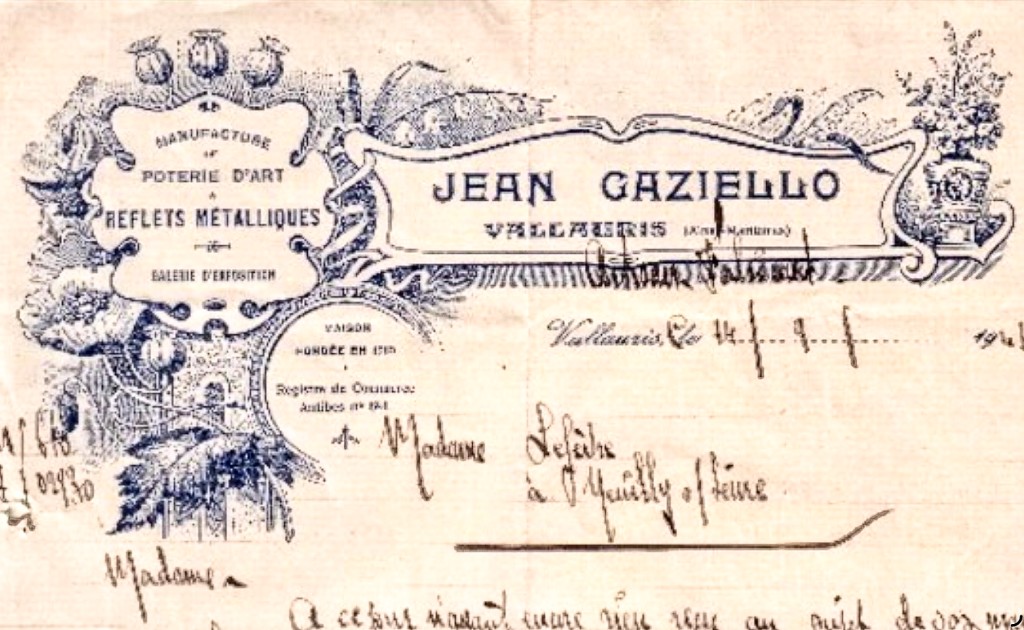
Jean-Baptiste Gaziëllo was born at Vallauris in 1871 into a ceramist family of Sicilian origin, and came into the trade beside an elder brother, Jean-Casimir, born in 1862 and himself a ceramic painter, with whom he is thought to have worked in the mid-1880s — exactly the years in which Clément Massier was launching the metallic lustres. His apprenticeship is recorded slightly differently by the two authorities: Paul Arthur has him apprenticed to Jérôme Massier from 1885 as a decorator, particularly on lustrewares, and signing competent lustre pieces for both Jérôme and Delphin Massier by 1896; the Declein catalogue has him working some years for Clément Massier and declines to fix the dates, placing them at the turn of the century. Either way he was inside the Massier orbit while the tradition was being made, and is a contemporary of that production rather than a later inheritor of it.
The decisive part of his formation was chemical. Alongside the Massier years he passed through L’Hospied at Golfe-Juan, the firm of enamel and materials merchants supplying the ceramists of the coast — which also furnished glaze preparations to Sèvres — and there had a small laboratory at his disposal in which to work out his own technique of metallic reflections. His first chemical compositions for the lustres are dated to 1907–08. From 1908 he worked independently alongside his friend the decorator Guiol, with whom he co-signed ceramics, and in 1910 he opened at Vallauris — the first of several shops, with the ateliers on the rue Sicard. His mark, “J. Gaziëllo / Fab / Vallauris A.M.”, where Fab abbreviates fabrique and A.M. the Alpes-Maritimes, asserts precisely the manufactory established in that year.
What distinguishes him from every other maker in the Vallauris lustre tradition is that his method is documented. Meticulous and highly organized, he wrote everything down: the composition of the pastes, the enamelling procedures, the firing times measured by pyrometric cones set in the kiln, the hours of lighting and charging and any relighting, every anomaly during firing, and then the results — the shades of lustre, whether handsome or very handsome, whether an object had metallized well or the reflections had come out badly. His metallic reflections required a third firing in a reducing atmosphere, the base enamel having been laid at the second; for the reds he devised compositions he named rubis ancien, or rose and rubino, incorporating cinnabar in the grinding, and for the golds he ground yellow ochre, silver nitrate, zinc and tin oxides and lamp black, thinned with vinegar and finished with chloride of gold. It amounted, in the Declein catalogue’s phrase, to the work of an expert chemist and a rigorous researcher. The same catalogue records that no comparable documents could be obtained from the descendants of Clément, Delphin or Jérôme Massier — so Gaziëllo’s notebooks are the only surviving technical account of how the Vallauris lustres were actually made, and the judgment there is that his own landscapes in metallic reflection are distinctly more elaborate technically than anything the Massiers produced.
The workshop prospered. In 1920 the town of Vallauris bought from him a large vase with metallic reflections and presented it to the President of the Republic, Paul Deschanel, on his visit to the town. He exhibited jointly with his son Noël, born in 1907, at the Nérolium in Vallauris in 1933 and again in 1935, and pieces exist signed by father and son together, among them a maritime plaque of the Îles de Lérins dated 2 February 1926. Gaziëllo ceded the firm to Noël in 1946 and died in 1957; the son continued to produce work of interest into the mid-1960s and the workshop closed in 1970. A caution for cataloguers: much of the trade gives the birth year as 1891 rather than 1871, an error that would make him an interwar figure and misdate his work by a generation.
Animals recur in the production, though rarely at the pitch of the vase here. The Declein collection at the Château-Musée of Vallauris holds three versions of a Panthère rugissante modeled in the round — one of them made to serve as an ashtray — in ruby, in brown-black, and in green, violet and mordoré lustres, together with a circular vide-poche decorated with birds and foliage under a crimson lustre. Beside these, the collection’s octopus vase is the outlier and the summit: where a panther is a sculpture that happens to be glazed and a vide-poche is a dish that happens to carry birds, the tentacle vase makes the creature and the vessel one thing, and turns the chemistry of the third firing — the shifting turquoise, violet and gold that Gaziëllo spent a career learning to control — into the mutable skin of the animal itself.
Literature
Arthur, Paul. French Art Nouveau Ceramics: An Illustrated Dictionary. Paris: Éditions Norma, 2015. The source for the birth at Vallauris in 1871, the apprenticeship with Jérôme Massier from 1885, L’Hospied & Cie, the partnership with Guiol from 1908, the foundation of the atelier in 1910 and the succession of Noël in 1946.
Azaïs. “Gaziello (Jean).” La Bergerie: Vallauris, céramique, céramistes, poterie [labergerie-vallauris.com]. Local research recording the workshop premises and the loss of a hand-painted book of models; gives the birth year as 1891, which Arthur corrects.
Declein, Jean, and Paulette Declein. Céramiques Art Nouveau: Collection Jean et Paulette Declein. Vallauris: Château-Musée, 1995. The essential source. Its chapter “Jean Gaziello et les reflets métalliques,” pp. 10–13, is the only account of his technical method, written with access to his notes and documents through his son Noël; the catalogue entries at nos. 126–149 record some two dozen pieces, and the collection of roughly 130 lustre wares entered the Château-Musée in 1994.
Further references cited by Arthur and not yet consulted: Makus 1981, p. 96; Haslam 1995; and Forest & Lacquemant 2000, p. 24 — the last almost certainly the Massier monograph already in the collection’s literature.