Artist Dossier
Émile Gallé
The presiding figure of Nancy, whose faience gave insects a range no other ceramist approached — observed with entomological exactness, enlarged until they command a vessel, and set marching in fable and procession.
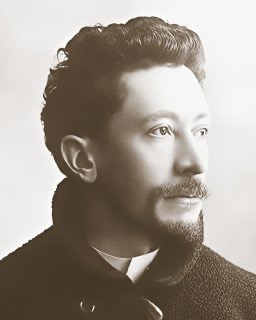
Biographical Note
Émile Gallé was the leading artistic personality of Nancy at the end of the nineteenth century and one of the principal architects of French Art Nouveau. The only child of Charles Gallé and Fanny Reinemer, he grew up within a family enterprise devoted to the sale and decoration of ceramics and glass. After studies and apprenticeships that included periods in Weimar and at the glassworks of Meisenthal, he joined his father’s business in 1867 and assumed control of it in 1877. Although Gallé is now best known for glass, ceramics constituted one of the most sustained and imaginative parts of his early career and brought him a gold medal at the Paris Exposition Universelle of 1889.
Gallé’s ceramic achievement was principally in faience. His earliest designs were executed through established Lorraine manufactories, including Saint-Clément and the Manufacture de Raon-l’Étape, before the expansion of his own Nancy workshops gave him a larger team of designers, modelers and decorators. His production ranged from table services and relatively conventional vessels to sculptural cachepots, animal figures and extraordinary asymmetrical forms. Medieval art, Rococo ceramics, Egyptian ornament and historical French pottery all entered his repertory, but Japonisme and the natural world increasingly displaced these eclectic sources. The Musée de l’École de Nancy, which preserves more than 250 of his ceramics, dates his active design of faience through approximately 1893; production diminished as Gallé concentrated upon glass and furniture.
Nature was not simply Gallé’s storehouse of decorative motifs. Botanical and zoological observation provided a method for constructing the entire object. Flowers, branches, roots, wings and carapaces determine profiles, handles and openings, while Japanese-inspired cropping and asymmetry frequently make a vessel appear to capture only one fragment of a larger living environment. Gallé’s ceramic surfaces could combine molded relief, painted enamels, barbotine, gilding, crackled grounds and deliberately contrasting textures. Unlike the high-fired stoneware of Carriès or Dalpayrat, his faience allowed brilliant and extremely detailed polychrome decoration, giving him the means to move between scientific precision, ornamental fantasy and pictorial narrative.
Insects occupy an exceptional place in this ceramic world. Cicadas, butterflies, moths, bees, beetles, dragonflies, grasshoppers, longhorn beetles and praying mantises appear with a diversity unmatched by any other major ceramist of the period. Gallé studied their anatomy closely—the segmented bodies, veined wings and jointed legs are often remarkably specific—but he did not restrict them to natural-history illustration. Insects may crawl across flowers, enlarge until they dominate a vessel, emerge in relief from its walls or participate in strange human-like ceremonies. Surviving drawings show how deliberately he designed these compositions: an 1881 study of a flying mantis was intended for both ceramics and glass, while another model specifies the colors for a faience vase populated by grasshoppers, butterflies, a longhorn beetle and other insects.
Gallé could treat insects as lyrical fragments of nature, but he also recognized their theatrical and unsettling possibilities. Praying mantises suggest watchfulness and predation; cicadas become monumental creatures whose wings organize the vessel; bees and butterflies animate luxuriant floral settings. In the celebrated Baldaquin jardinière, insects form a fantastic procession recalling the anthropomorphic animal satires of Grandville: crickets carry a pale mantis in a palanquin while another insect leads the ceremony. Such works collapse distinctions among naturalism, caricature and fairy tale. No other ceramist moved so freely from the exact observation of an insect to its transformation into character, symbol and structural ornament.
Gallé’s ceramic production was largely complete before the formal establishment of the École de Nancy in 1901, yet it anticipated nearly every principle for which that movement became known: fidelity to nature, unity between form and decoration, collaboration among specialized artists and craftsmen, and the elevation of the decorative object into an intellectually ambitious work of art. Within the Bestiaire, Gallé is indispensable not merely because of the number and variety of his animals, but because he expanded the possibilities of what an animal could do upon a ceramic object. His insects observe, perform, threaten, parody and transform; even the smallest creature becomes capable of directing the entire composition.
Literature
Bernd Hakenjos, ed., Keramik von Emile Gallé, exhibition catalogue, Düsseldorf: Hetjens-Museum, Deutsches Keramikmuseum, 1981. This 131-page catalogue remains the most important publication devoted exclusively to Gallé’s ceramics and documents an unusually broad range of forms, decorations and sculptural subjects.
Musée de l’École de Nancy, La céramique de Gallé, conservée au musée, Nancy: Musée de l’École de Nancy, 1984. Based upon the museum’s exceptional holdings, this 159-page catalogue is fundamental for models, marks, production history, collaborators and decorative variants.
Philippe Garner, Emile Gallé, New York: Rizzoli, 1979, especially pp. 65–75. Although it surveys Gallé’s entire career, its ceramics chapter remains an excellent English-language introduction and illustrates several of his most inventive zoomorphic and insect-related works.
Monique Nonne, Philippe Thiébaut et al., Gallé, exhibition catalogue, Musée du Luxembourg, Paris: Réunion des musées nationaux, 1985. The catalogue treats ceramics alongside glass and furniture and remains particularly useful for placing Gallé’s faience within his broader naturalist and Symbolist development.
Paul Arthur, French Art Nouveau Ceramics: An Illustrated Dictionary, Paris: Éditions Norma, 2015. The Gallé entry and related illustrated objects provide an important modern assessment of his ceramics within the wider context of French Art Nouveau production.