Artist Dossier
Albert-Louis Dammouse
Born into the Sèvres manufactory and trained as a sculptor, Dammouse spent fifty-five years in his own studio in the same town pursuing one material problem after another — pâte-sur-pâte, stoneware, faience, and finally the pâte d’émail he invented — and his fish, salamanders and marine creatures do not sit upon the glaze but half-dissolve into it.
Biographical Note
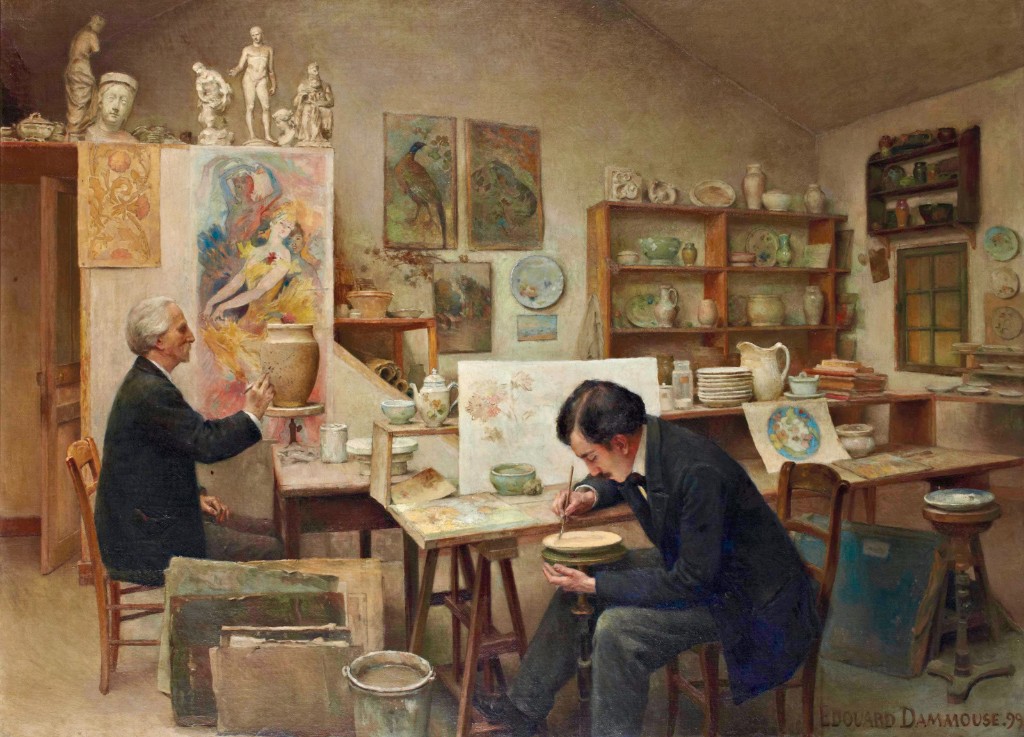
Albert-Louis Dammouse was born in Paris on 22 October 1848, the son of the sculptor Pierre-Adolphe Dammouse (1817–1880), who worked at the Manufacture de Sèvres, and of Rose Victoire Papy. His younger brother Édouard-Alexandre, born in 1850, became a painter and ceramic decorator, and the two would eventually share a studio. Albert studied at the École nationale des arts décoratifs from 1863 to 1868 and then entered the École des beaux-arts, training as a sculptor in the atelier of François Jouffroy, for whom he executed carving on the Louvre. He made his Salon debut in 1869 with a plaster portrait bust. Between 1868 and 1870 he worked alongside Marc-Louis Solon, called Milès, a decorator at the Manufacture, and learned from him the technique of pâte-sur-pâte. In 1871 he set up his own porcelain-decorating studio at Sèvres, which he would keep for the remaining fifty-five years of his life.
The two decades that followed were spent working for other people’s houses, and they made him. In 1874 he began designing for the Limoges porcelain manufacturers Pouyat and Dubreuil and took a gold medal at the Union centrale des arts décoratifs; from 1875 he collaborated with the painter and etcher Félix Bracquemond, one of the central figures of French Japonisme. Between 1882 and 1886 he worked under Ernest Chaplet in Charles Haviland’s atelier at Auteuil and then in the rue Blomet, and it was there that he discovered stoneware — the material that would carry most of his animal subjects. His brother Édouard was in the same workshops. When Haviland’s ateliers closed in the winter of 1885–86 the brothers withdrew to Sèvres to work together at 12 rue des Fontaines. Dammouse was received into the Société nationale des beaux-arts in 1889, the year he won a gold medal at the Exposition Universelle, became its secretary in 1891 and sat on its jury in 1893. In 1892 he built his own kiln, and from that point he was answerable to nobody’s programme but his own.
What followed was an unusually restless technical career. Dammouse moved from hard-paste porcelain with grand-feu decoration into stoneware and faience, preferring the latter for the wider range of color it allowed him, and he pursued flowing and flamed glazes, sang-de-bœuf, and underglaze effects. From 1897 he took up pâte de verre, the process revived by Henry Cros, working on it with the sculptor Jean-Désiré Ringel d’Illzach in the Sèvres kiln; and from about 1898 he developed out of it the pâte d’émail that is now his best-known invention — small translucent bowls and floriform cups in which enamel is cloisonné by a harder enamel and lit from within. It was the first application of Cros’s material, until then confined to relief, to the vessel. He sat on the examining commission of the École de céramique at Sèvres from 1895, and was made a commander of the Legion of Honour in the year of his death.
His animals belong overwhelmingly to the water. Fish move through his stoneware chargers and pitchers among seaweed and wave relief; a monumental Divinité marine of 1898 in glazed stoneware is among his most ambitious works; salamanders and lizards recur, sometimes modeled by other hands, since he edited sculptors’ models as well as making his own — Pierre Roche supplied him with a swimming lizard for a circular plate, and the sculptor Charlotte Besnard modeled the Salamandre he showed at the Salon of 1903. Occasionally the animal escapes the vessel altogether, as in the small enameled terracotta seal he made for his own use, a cockerel perched on a block over his AD monogram, cut in the spirit of a Chinese cachet. But the characteristic Dammouse animal is the one that does not fully arrive: a carp whose head lifts into relief while its body stays half-absorbed into a field of turquoise and aubergine, present as much through the behavior of the glaze as through modeling.
That is what earns him his place here. Dammouse belongs with the ceramists for whom the creature and the surface are a single problem rather than two, and his particular solution — emergence, partial and atmospheric — sits at a measurable distance from the declarative relief of a Massier koi or the wholly sculptural fish of the school of Carriès. He also stands at the meeting point of several strands the Bestiaire documents elsewhere: the Haviland workshops under Chaplet, the Japonisme of Bracquemond, the editing of sculptors’ models, and the technical experiment that runs from grand-feu stoneware to pâte d’émail. He died at Sèvres on 19 June 1926 and is buried in the cimetière des Bruyères there. His work is held by the musée d’Orsay, the musée des Arts décoratifs, the Petit Palais and the palais Galliera in Paris, the musée national de Céramique at Sèvres and the musée Adrien-Dubouché at Limoges, as well as in Germany, the United States and Japan.
Literature
Arthur, Paul. French Art Nouveau Ceramics: An Illustrated Dictionary. Paris: Éditions Norma, 2015, ill. p. 57. Illustrates the Salamandre of about 1903, modeled with Charlotte Besnard.
L’Art décoratif aux expositions des beaux-arts. Paris: Armand Guérinet, 1903, pl. 1. Contemporary plate of the Salamandre as shown at the Société nationale des beaux-arts; see also Art et Décoration, June 1903, p. 200.
Garnier, Édouard. “Albert Dammouse.” Art et Décoration, vol. VI, 2nd semester, October 1899, pp. 97–105. A substantial contemporary profile, published in the same year as the studio portrait below.
Gherardt, Jean-Luc, Bernard Jacqué and Arnaud Lang. Céramique Art Nouveau: Collection du Musée de l’Impression sur Étoffes, Mulhouse. Mulhouse: Production Maison de la Céramique — Centre d’Art International, 1990, pp. 20–21. The reference the salerooms cite for Dammouse’s enameled stonewares; the author’s name also appears as Gerhardt and the spelling should be checked against the title page.
Rheims, Maurice. L’Objet 1900. Paris, 1964, pp. 124 and 130, ill. 77. An early modern account, and the standard citation for the pâte d’émail.
Thiébaut, Philippe, Olivier Gabet, Emmanuelle Héran and Marie-Madeleine Massé. Un ensemble Art Nouveau: la donation Rispal. Paris: Musée d’Orsay, 2006. Places Dammouse within the Orsay holdings and the wider Art Nouveau donation.
Vogt, Georges. Exposition universelle internationale de 1900 à Paris: rapport du jury international, groupe XII, classe 72, Céramique. Paris, 1902. The official jury report, and the primary source for how Dammouse’s work was judged at 1900.