Artist Dossier
Alexandre Bigot
A physics and chemistry teacher converted to clay by the Chinese porcelains he saw at the 1889 Exposition, Bigot became the great grand-feu chemist of Art Nouveau — glazing the façades of Guimard and Lavirotte while modeling animals of his own with a naturalist's quiet economy.
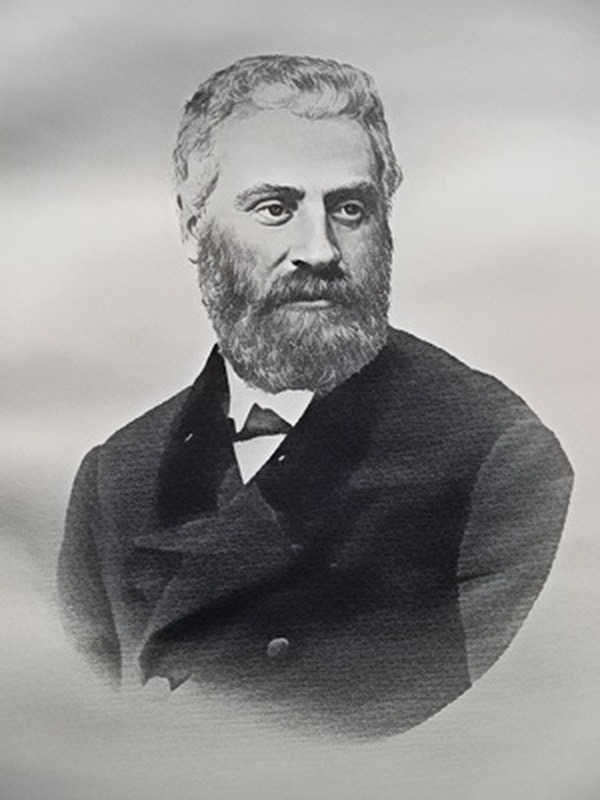
Biographical Note
Pierre-Alexandre Bigot was born at Mer in the Loir-et-Cher on November 5, 1862, the son of a winegrower and farmer. A scholarship took him to the Collège de Blois at ten; he later studied at the École Alsacienne in Paris, received his degree in physical sciences in 1884, and joined the laboratory of the distinguished chemist and mineralogist Charles Friedel. Bigot taught at the École Alsacienne while preparing a doctorate in organic chemistry, Sur quelques dérivés de la glycérine, which he defended in 1890. His scientific formation was not incidental to his later ceramics: minerals, crystalline structures, color, heat and the chemical behavior of materials became the intellectual basis of his art.
The Exposition Universelle of 1889 proved catalytic. East Asian ceramics—particularly Japanese and Korean wares—suggested possibilities very different from the decorated porcelain then dominant in France, and Bigot began experimenting with ceramic bodies, glazes and high-temperature firing, installing a potter’s wheel and experimental kiln alongside his scientific work. He corresponded with Jean Carriès, advised other ceramists including Ernest Chaplet, and developed a growing repertory of matte, crystalline and flowing glazes. In 1894 he exhibited at the Salon de la Société nationale des Beaux-Arts, where his deliberately simple stoneware forms placed the emphasis on material and glaze rather than elaborate ornament. The Musée d’Orsay preserves several signed and precisely dated works from this formative period.
Bigot’s earliest animal ceramics are especially revealing because they precede the large collaborative manufactory with which his name became associated. Contemporary accounts of his 1894 exhibition describe small vessels ornamented with newts, frogs and snakes, and reported that the works shown there had been modeled by Bigot himself. He therefore should not be reduced to a technician who merely fired other artists’ sculpture: at the outset of his ceramic career he was personally designing and modeling. As his enterprise grew, however, authorship became more complex. Bigot increasingly placed his technical mastery at the service of other creators, turning models by sculptors into high-fired, polychrome stoneware and working with architects to make ceramic sculpture integral to the modern building.
This capacity for collaboration became one of Bigot’s defining achievements. His circle eventually included Pierre Roche, Paul Jouve, Jean-Baptiste Larrivé, Alfred-Jean Halou, Camille Alaphilippe, Antoine Bourdelle and his own brother, the animal sculptor Raymond Bigot, as well as architects such as Hector Guimard, Jules Lavirotte, Henri Sauvage, Anatole de Baudot and André Arfvidson. In such works Bigot was not simply the manufacturer: clay body, shrinkage, firing temperature and glaze could fundamentally alter a sculptor’s model, and his technical decisions became part of the finished work. His own formulation of the relationship was similarly collaborative—he sought to place his artistic and scientific knowledge at the disposal of architects creating individual designs.
Bigot’s career thus occupies an unusual position between artist-potter and industrial ceramist. His finest work depends less upon a recognizable repertoire of shapes than upon his command of ceramic surface: muted browns, ochres and greens, violet and turquoise passages, crystalline eruptions and glazes that flow over relief as though weathering stone. He received major recognition at the Exposition Universelle of 1900 and was made a chevalier of the Légion d’honneur that year. After withdrawing from large-scale production around the First World War, he continued as a technical authority on ceramics and maintained his interest in glaze chemistry; patents associated with his research extend well beyond his Art Nouveau period. He died at his Paris home on April 11, 1927.
Literature
Hélène Bédague, Alexandre Bigot, chimiste & céramiste. Paris: Éditions Louvre Victoire, 2016. The fundamental modern monograph, based on extensive archival and technical research and essential for both Bigot’s biography and the history of his manufactory.
Paul Arthur, French Art Nouveau Ceramics: An Illustrated Dictionary. Paris: Éditions Norma, 2015, pp. 56–59. Particularly useful for Bigot’s art pottery, collaborations with sculptors and architects, marks, animal models and the complicated final years of the enterprise.
Camille Napolitano, La maison aux majoliques de la rue Campagne-Première: L’immeuble d’ateliers pour artistes d’André-Louis Arfvidson, prototype d’un modèle architectural moderne. Master 2 research thesis, École pratique des hautes études, 2018. The study contains an exceptionally useful archival reconstruction of Bigot’s education, factory, company structure, catalogues and architectural collaborations.
Alexandre Bigot, “Les recherches céramiques concernant les grès et les émaux de grand feu,” La Céramique, no. 120, 1900, pp. 117–120. Bigot’s own account of his technical and aesthetic approach to high-fired stoneware and glaze.
Object Records
No linked object records yet.